Predictions for 2026 Games Sustainability Trends


Maybe its getting older. Maybe it’s the pace and intensity of the modern always connected life, or perhaps its the genuinely pretty dire state of the hope to keep global warming “well below 2ºC” and stave off the worst of sea level rise, droughts, floods, and storms of an increasingly extreme nature. Whatever it is, I’m feeling very much like the edit to the 30 Rock meme in the header above. Lemon it’s only February.
At the start of a new year, reflecting back on all we accomplished in the last one (did you know we wrote and released an entire first draft of a global standard with the potential to dramatically accelerate sustainability for the $200bn games industry?) has got me thinking about what the year ahead will, could, or perhaps should be like. Future predictions are always inadvisable, and they do have the tendency to say more about the one doing the predicting than any real state of affairs, and absolutely nothing is guaranteed, after all. But at the risk of revealing the shape of my own internal thinking about what’s going on, here’s a few of the things that I think might be coming this year. A few of the major trends which will have ramifications on the sustainability of the games industry.
If I had more resources (and time, mainly time, actually) these could take the form of full scenarios – sort of like what the IEA does every few years. But lacking the resources, research, and expertise of those global orgs, instead you get my best guesses, my stab in the dark. It’s a mix of genuine prediction based on the possibilities I can see, and a decent dose of hopium which is so, so necessary to hold onto in the face of some pretty unrelentingly bleak news about global sustainability efforts.
1. Energy efficiency in games takes off in 2026
We’ve had several years of learnings on how and why we can save wasted energy from game menus and idle states, as pioneered by the Xbox sustainability team under the leadership of Trista Patterson, and carried forwards by too many people to count. We know how to do it (timer + setMaxFPS), what the implementation challenges are (make it a default option; educating users so they don’t go turning it off), and even how to scale it to some degree (sometimes it only takes one engineers in each company, each development team, to make it work). It’s such low hanging fruit, there’s absoultely no reason not to do it.
But it’s time to go beyond this starting place, and get deeper into how much energy the huge, billion-strong mass of gamers consumes on a daily basis. Our SGA meetup with Torbjorn Soderman from GOALS in December outlined some first steps in this direction – optimising for lower hardware temperatures, and less fan noise, is actually getting super easy, and super important for high end hardware.
But how do we make it happen? There’s a few possibilities. One pathway is the individual dev team approach, much like how EcoModes get embedded in games individually. Though this is slow, at least it works. Perhaps individual teams will hear about this new capability and lean into it – though someone will still need to tell them, and in ways and places they’re capable of hearing. This is something that should be quite achievable – it means a better user experience, after all. In this pathway, the most competitive, lean, and hungry teams adopt this first – as they know it gives an edge to their games in the hypercompetitive modern games marketplace; adding a perceptible, but background tenor to the user experience. It’s attention to detail.
Another, faster perhaps, pathway might be through more systematic means – for instance, by enabling these capabilities through a super easy to use plugin for game engines. A plugin that monitors the power and temperatures and manages maximum FPS for you dynamically. Or perhaps its via a dashboard that one of the platforms provide to you, giving you the ability and the incentive to reduce this now-visible energy consumption? In that vein, perhaps it’s enabled by the development of some sort of software carbon intensity metric for games, which starts to appear in marketing comms, on storefronts and websites as customers increase their awareness of sustainability and green products. Electricity prices and the cost of living sure isn’t getting any cheaper for most of the world. This would take some work to get right for games – but I think we’re up for it. It would companies some more confidence that they can actually hit net zero targets, and have some actual control over downstream impacts. Does anyone feel like that in the games industry right now?
2. The heat comes off the AI bubble, enabling responsible AI
This one seems to be already happening, thank goodness, to some degree, as the exuberance of early investors and the seemingly endless hype begins colliding with the reality that most AI services are basically fine but some are actually truly awful, and all these crazy speculative investments have to somehow now pay for themselves or else lots of people are going to lose a truly historic amounts of money. The take that I thought was most realistic was “the hyperscalers may be able to make their customers pay for it with higher prices but everyone else is out of luck”. My work Gmail cost went up 18% this year “reflecting the substantial added value” of AI tools (which I refuse to use).
And plenty of smart people are beginning to refuse to use them. Some represent just way too much risk, far too much unreliability. One of the under-appreciated boons of boolean logic is just how black and white it is. The chief virtue of calculation is meant to be its reliability, and probabilistic AI systems break this most fundamental rule. Some AI services are just also a very marginal improvement over whatever they replace, and at a substantially higher energy intensity and cost. Some are genuinely useful – like AI transcription, translation, note-taking, and a I’m sure a handful of others – but now even these useful tools face an increasingly wary consumer who has been burned by AI slop and hallucinations enough times to get wise. AI has over-promised and under-delivered, by and large.
With the initial flurry of breathless activity now behind us, I am optimistic that moreresponsible AI is on the horizon in 2026. We talked a bit about that vision, and what it means for us as practitioners and creatives in the games industry in our SGA meetup this week:
One of the key observations I make in the talk is that lower impact AI requires smaller, more specific models. As general purpose “do everything” models are trusted less by the most sophisticated users, and as the largest companies like OpenAI pull back from claims (and deals) they can no longer pay for, it might enable a shift in focus. I would be very glad to see increasing focus shifting up the chain – to ensuring that AI is trained with responsibly and ethically sourced datasets, powered by renewable energy, and with preferences given to more task-specific models that run on modest hardware. 7 billion parameter models are more likely to be trained on a data set that hasn’t been stolen from authors and creatives, and also more likely to uses less energy in training (and at run-time!) than a 70 billion parameter frontier model that marginally moves the needle but still can’t count how many ‘R’s are in the word “Strawberry” better than a wildcard search.
The AI pot coming off the boil hopefully enables us to lift the lid on many of these black boxes and get at the details we need. Let 2026 be the year of transparency and clarity in AI, in turn enabling responsible use in game industry workflows that is a bit more critical, and a bit more trustworthy.
3 Geopolitical disruptions continue to wreak havoc on gaming hardware
In 2022/23 it was the demand for GPUs and ASICs for crypto mining that placed pressure on gaming hardware prices. In 2025/26 it’s currently DDR5 RAM manufacturers switching their focus to higher-margin, high-bandwidth memory (HBM) for AI applications that is causing headaches for the gamers, with trickle down consequences on the availability of hardware. Valve have already had to delay their Steam Machine. If portable gaming PC hardware - like the Steam deck, and Xbox/Windows handhelds – has been the surprise hit of the past couple of years, component availability and pricing could be a headwind that continues to dampen growth and demand.
If you have a spare hour, this history of Chinese upstart RAM manufacturers and their intensive efforts to play catchup in order to disrupt huge, monopolistic incumbents is super fascinating.
I think the most obvious way this translates practically to the games industry this year is as a pressure to keep older hardware working, and reduced demand for upgrades to chase the newest and fastest hardware. Years between console generations have been growing, and the PC ecosystem is only increasing in diversity with bigger and bigger gaps between new and old hardware. Remember how, last year, a lot of hope was resting on the Switch 2 to boost the industry out of the doldrums? I think the “new hardware will save us” story is getting harder and harder to believe. I don’t know what the answer is – a return to game design fundamentals? Double down on discovery??
Another answer might be to go entirely the other way – double down on obsolete hardware. Some of the biggest games in the world are already ones that run on anything – I can only imagine that trend continuing, and annual game franchises that once sold themselves mainly on bigger and better, more impressive graphics keep on losing audiences and market share. You might think that Battlefield 6 maybe speaks in the opposite direction – but have a look at these recommended specs:
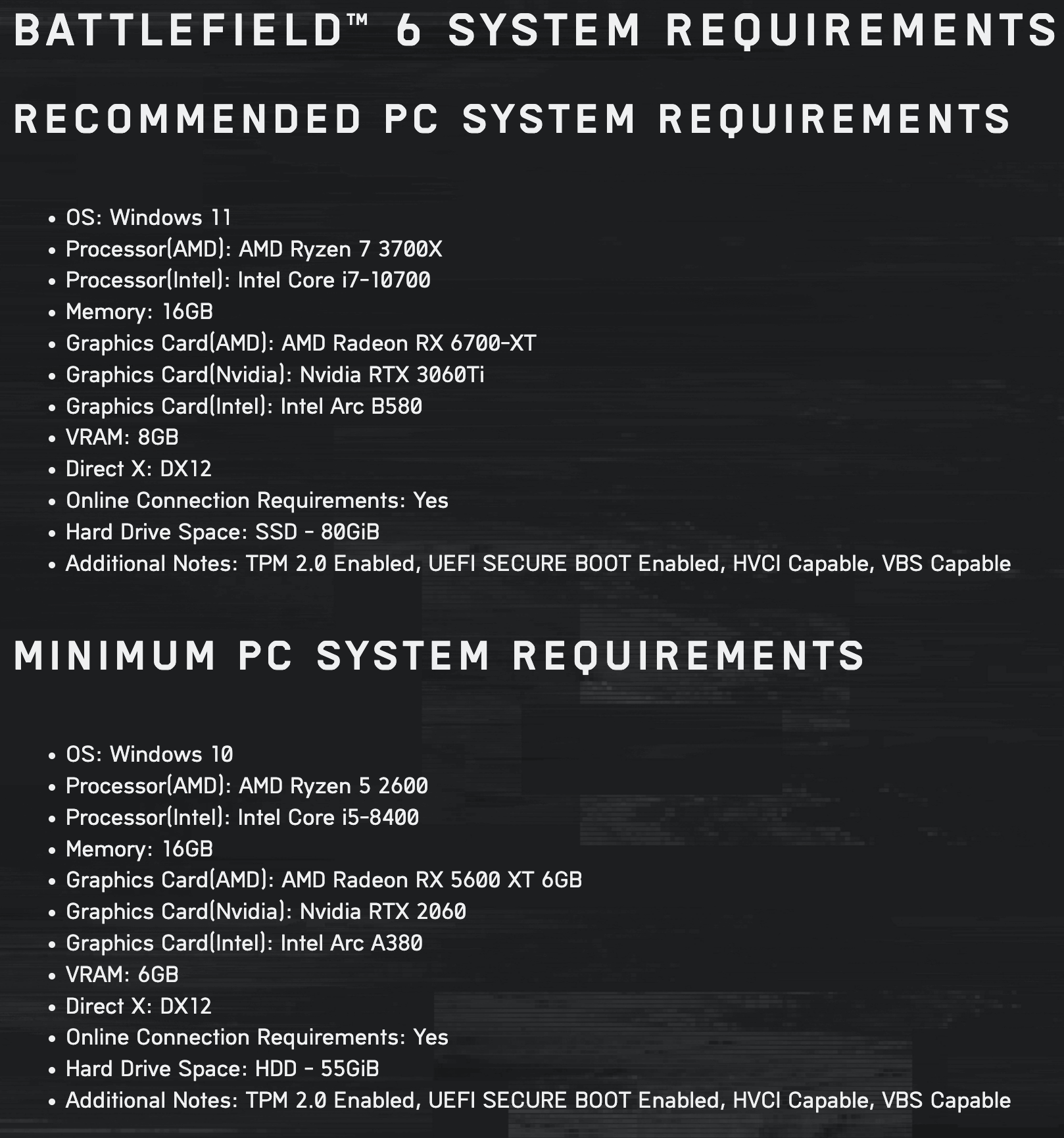
That’s a 6 year old Nvidia GPU, two architecture generations old. Yes it’s a powerful one, but also… you apparently get the “recommended” experience with it? Just something to consider.
4. Despite the EU’s omnibus, nature is still upstream of gaming
This is also hardly going out on a limb, but much like how we say “nature is upstream of the economy”, I suspect 2026 will continue to remind us that politics is upstream of the games industry.
So 2025 was the year of deregulation, riding the political wave of Trumpian populism and a green backlash (at least, a partial one). Even though the EU trilogue has settled on CSRD and CSDDD thresholds that are higher than many of us might have liked, I think the learning process from the lead-up to implementation by first and second wave companies means that first, institutional knowledge inside companies is higher than it would have ben , and secondly expectations from stakeholders are going to remain high – especially for public game companies. ESG investors looking to make big long term investments still want to know that games businesses have a plan to mitigate their climate impact, and see that they’re aware of the risks to service continuity, and have strategies to deal with them. Do you know where your cloud is physically located? Do you know what sort of water stress the data centre is putting local supplies under? How will your campus cope with extreme weather? What contingency plans do you have for disruptions? Can you prove resiliency beyond writing a few lines in an annual report?
If there’s one thing that we can bank on this year, it’s that climate disasters – fires, floods, storms, and more – are only getting worse. It might not be 2026 that The Big One hits somewhere hard, that really hurts, or shakes expectations. But it is another roll of the increasingly loaded dice, another chance at summer heat waves, another chance at stressed infrastructure, another chance for fires and floods and all sorts of physical disasters we aren’t even planning for yet. Ensuring real resilience for service based games is going to set some organisations apart. Its also going to be more important for some parts of the world than others, and as we have seen, it’s frontline communities usually far away from where we work and play that are paying the price for the delays in decarbonising advanced economies. We’re making some halting and uneven progress – it’s not all bad news – but we’re not moving nearly fast enough.
As climate scientist Kevin Anderson put, it’s “A Velvet or Violent Climate Revolution: which will we choose?”
I find Kevin's explanations really clear and helpful. Hopefully these predictions are helpful for you as well.
Thanks for reading a little bit more speculative and shambolic Greening the Games Industry this week. I'm off on a trip across Europe over the next few weeks so please excuse if there's gaps in the regular schedule.
I dedicate a lot of time and effort to this newsletter, and I hope it shows through. If you find it useful, or just want to ensure the posts continue, please consider becoming a supporter for a few dollars a month or an annual subscription for even less.