Business Sustainability Standard Support, Cross-Border Carbon, and CO2 Mortality – GTG Links 70


One month into 2026 and it's already another eventful year. Sending my solidarity to any and all readers protesting ICE goons in the US. This week's newsletter is heavy on the business side of things, but ends with some super interesting research on mortality rates associated with each tonne of carbon emissions. Lots of stuff to chew over!
Late last year CDProjektRED sold off GOG.com to CDPR co-founder Michał Kiciński. It will keep distributing games on GOG, but it no longer owns the business:
Following the execution of the Purchase Agreement, the Company executed a distribution agreement with GOG regarding distribution of the Company’s games via GOG platform, defining the scope of their cooperation, including the new payment terms within the first six years following the execution of the Purchase Agreement.
The sale of shares in GOG is consistent with the CD PROJEKT Group growth strategy, which assumes focusing on the core business of the Company, i.e. developing and publishing of video games and related projects based on the owned and new franchises.


On the one hand this will be nice for CDPR's GHG disclosures, as they won't no have to report S3.11 emissions from GOG sales (downloads!) anymore. That should bring them into more comparable territory with other game developers, and I will be curious to see the result – it will be a very interesting shift. On the other hand, this is one of the few game distribution platforms which actually disclosed emissions, and it's now moving into private ownership (probably) outside the scope of mandatory disclosures. A little unfortunate!
Anyway this is all somewhat moot, as the EU Omnibus proposal (once it passes) will raises the threshold above the size of CDPR meaning… well, no more mandatory reporting? I am hopeful they continue to report voluntarily (after all, they’re so good at it and have invested a lot of time and effort) and investors will still be looking for ESG data. But anything is possible...
Davos: Big corporate acceptance of IFRS sustainability standards
If you skip to ~24 minutes into this panel from Davos, you too can hear Bank of America's CEO Brian Moynihan hand-wave away the ridiculous high-standards of the EU's CSRD (err... sure?) in favour of the ISSB's IFRS standards. It's by no means a totally coherent or cogent utterance – the whole panel is somewhat overshadowed by the unhinged US commerce secretary who clearly gets a lot of pleasure out of outing out the role of Big Swinging Dick – but I digress! We here at GTG appreciate the IFRS standards as an important minimum viable baseline, but they're the necessary but not sufficient requirement given the urgency of our climate crisis and the task of decarbonisation... so YMMV? Our takeaway is that even the biggest, most influential business expects some minimum level of sustainability disclosures – some barebones form of ESG is now baked in, for better or for worse!
The EU's Cross-Border Adjustment Mechanism (CBAM) is starting
Unlikely to affect the games industry except in the most indirect ways – building a new campus? Steel and concrete might be a little more expensive, but more likely this is a small enough component on a big project to be a rounding error. But it might have downstream impacts through higher expectations and capabilities for data sharing around products:
“Under CBAM, a carbon charge is added to imports of carbon-intensive goods such as cement, fertilisers and aluminium into Europe from countries without an equivalent emissions trading system. From 2026, EU importers will be required to purchase and surrender CBAM certificates reflecting the carbon content of the goods they import, effectively extending the EU carbon price to selected imports.
…
However, the new rules allow importers to reduce their CBAM liability if they can demonstrate that a carbon price has already been paid or that lower-carbon electricity was used in production. Where electricity is supplied under a PPA, producers may apply an actual emission factor instead of the grid average. The Commission places physical, hourly delivery of electricity at the core of this approach and requires contractual evidence of a PPA directly linking the authorised CBAM declarant to a third-country electricity producer, covering the relevant volumes and time periods. To demonstrate a direct technical link, producers must provide a simple grid diagram showing the connection between the production site and the electricity generation source. They must also supply smart meter data confirming that the electricity used was delivered within the same hourly measurement period.
The potential to avoid the CBAM import cost at the border if you can prove you've got hourly matched renewable energy could catalyse new systems that then migrate out to other products. As these capabilities become more widespread, and as producers and purchasers get more sophisticated, we could see this come to other fields like data centre services, digital services, and so on. This month the GHG Protocol consult on Scope 2 is also gathering views on the new hourly matched reporting proposed for its new revision... (more on that in a moment).
You can read the full analysis by Pexapark below.
 January 20th, 2026 By Victoria Santos, Renewable Energy Markets & Pricing Analyst
Jim Boyle of Sustainability Roundtable on the Pexapark Podcast talks corporate sustainability & the GHG Protocol
With some remarkable frankness, this discussion about the benefit from removal of subsidies for renewables ends up being quite illuminating. In short, Boyle sees renewable subsidies as “bad for our [physical planetary] ecosystem… good for those going long on PPAs because it adds upward power price pressure.” It's nice to hear someone clearly articulate where business interests are directly in competition with, well, the survival of life on earth. It's kind of refreshing, even if it is also... horrifying? Yes, I think so.
But the second half turns into a discussion of the potential changes to the GHG Protocol around 24/7 power matching. One point Boyle makes is that renewable developers aren’t typically experts in GHG accounting standards – they're engineers not eggheads (like yours truly). It ends up being a pretty good back and forth about a tough, thorny issue. Namely, “what is the most effective approach to decarbonising energy” and “how do we get renewables built” and “how do we get them built where they actually matter and have the most environmental benefit?” There’s a really interesting argument that the global nature of CO2 emissions, which is an interesting interpretation too, since it doesn’t really matter that much where CO2 gets emitted, as it all (we assume) mixes in the atmosphere... so we should be hunting down where renewable projects are the most effective as displacing fossil fuels. It's a compelling argument, and paired with the 24/7 energy discussion really something to chew over.
Boyle thinks that (mandatory) hourly matching in-grid (as proposed by the current GHG Protocol Scope 2 consultation) would result in less renewables being built. The hyperscalers can do it, but as he notes “there’s only 7 of them… yes they sometimes make up 50% of the market demand, but you’re losing the other half of caused procurements…” Tricky stuff!
 January 15th, 2026
The solar revolution in China is chaos
...chroniclers of this green tech revolution almost always understate its chaos. At this point, it is far less a tightly managed, top-down creation of state subsidies than a runaway train of competition. The resulting, onrushing utopia is anything but neat. It is a panorama of coal communities decimated, price wars sweeping across one market after another, and electrical grids destabilizing as they become more central to the energy system. And absolutely no one—least of all some monolithic “China” at the control switch—knows how to deal with its repercussions.
 Jeremy Wallace
And a great new review of Fressoz’ “more and more and more” which looks through the lens of recent "abundance" discourse and recent history since the 70s.
 Zachariah Webb
Ukrainian figures out how to power his PC with a DC battery
How cool is this? Very cool.
The Sony x Honda EV seems pretty disappointing
Baffling that the world still seems flat-footed on EVs compared to the Chinese giants – years after we first saw what they're capable of!
 Luke Plunkett
Review of storage media emissions
Drawing on existing Life Cycle Assessment (LCA) and Product Carbon Footprint (PCF) results, we identify substantial gaps and discrepancies in current industry assessments, including inconsistent scope, data variability, and lack of standardisation. Furthermore, we propose a comprehensive environmental impact framework and apply it to three HDDs, yielding an average embodied emission estimate of 13.3 kg CO₂ per drive
Enabled emissions by AI
The fact that Microsoft keeps allowing AI to be used for oil and gas exploration and extraction should be the biggest scandal of the whole AI "revolution". Almost completely overlooked, and recall that the planet doesn't care whose 'GHG inventory' emissions appear on – it just cares about global concentrations.
 Lars Sellien Senior Communications Advisor
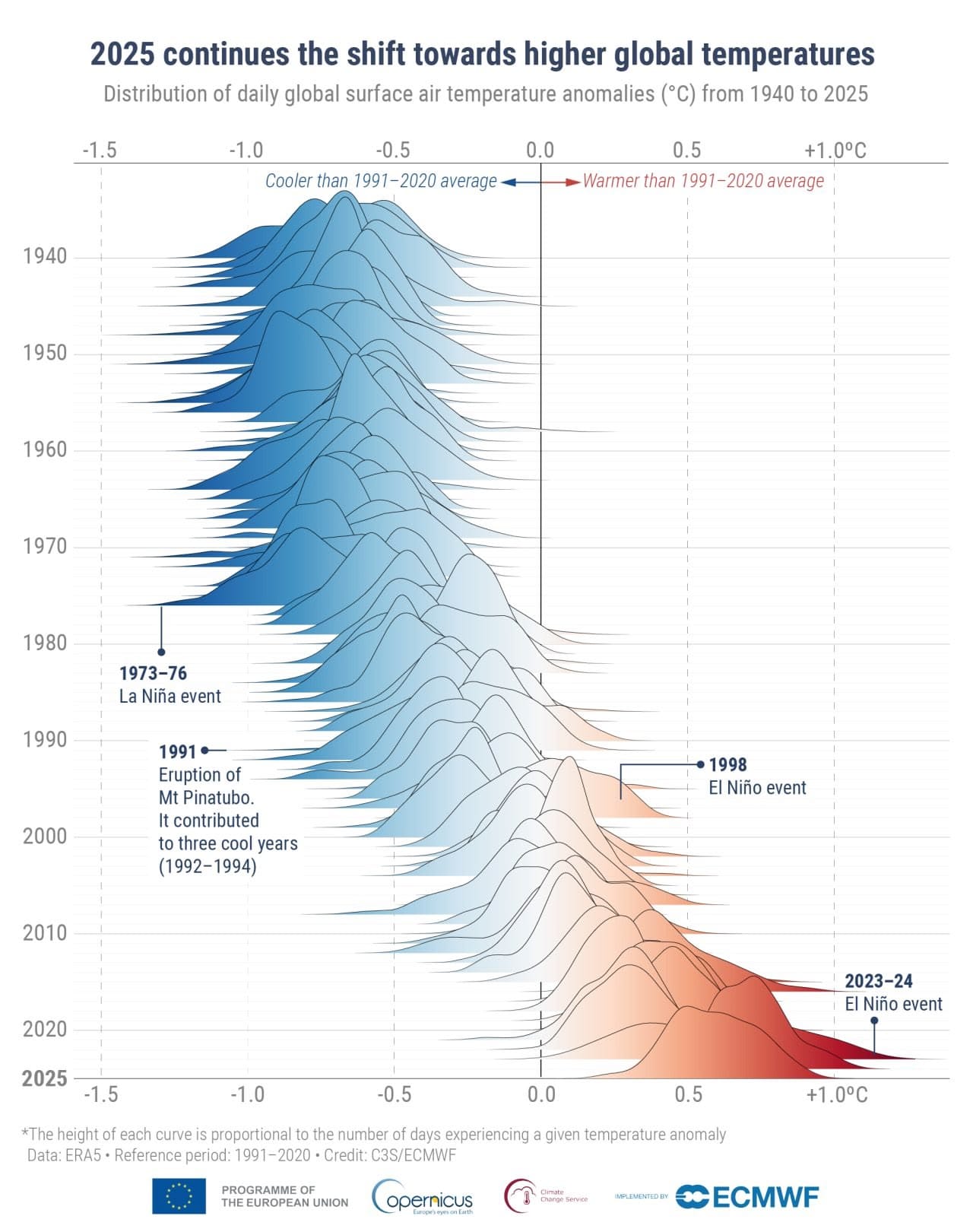
The past three years have ben the hottest on record
…the last three years have been the hottest on record, regardless of the order,” said Professor Sarah Perkins-Kirkpatrick, a climate scientist at Australian National University. “As a globe, when you average out all of the [regional] variability, the signal is very, very strong, and it’s just getting stronger almost year on year.
 Caitlin Fitzsimmons
And the latest visualisation of the past 80-odd years of climate change from the Copernicus observatory sure is uhhhhh something!
Climate change now detectable from any single day of weather at global scale
The fingerprint of climate change is detected from any single day in the observed global record since early 2012, and since 1999 on the basis of a year of data. Detection is robust even when ignoring the long-term global warming trend. This complements traditional climate change detection, but also opens broader perspectives for the communication of regional weather events, modifying the climate change narrative: while changes in weather locally are emerging over decades, global climate change is now detected instantaneously.
 Sebastian Sippel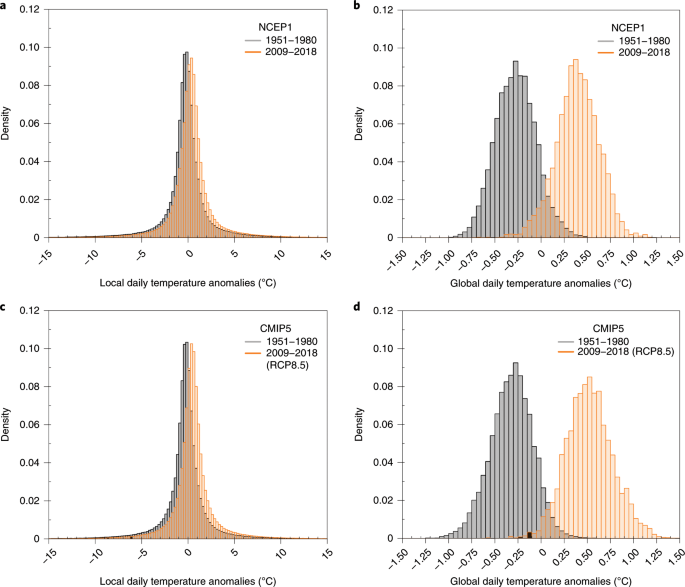
How many people does a tonne of CO2 kill?
New research extends the idea of the "social cost of carbon" which puts a figure on how much damage is done by each tonne, now identifying the mortality cost of carbon.
In the baseline emissions scenario, the 2020 MCC is 2.26 × 10‒4 [low to high estimate −1.71× 10‒4 to 6.78 × 10‒4] excess deaths per metric ton of 2020 emissions. This implies that adding 4,434 metric tons of carbon dioxide in 2020—equivalent to the lifetime emissions of 3.5 average Americans—causes one excess death globally in expectation between 2020-2100.
Maybe we should be putting death numbers in our annual reports? How many deaths has the game industry caused? About 50 million tonnes of CO2e is roughly what I think the whole industry is responsible for, so about 11,000 excess deaths over the next 80 years... from just one year of game industry emissions.
Alternatively, how many potential excess deaths did Fortnite's Eco Mode save? They don't try to put an emissions total on their savings, just sticking to energy, but if we plug the energy figure into the US EPA carbon equivalencies calculator that's maybe about 49,045 tones of CO2 avoided! That's ELEVEN excess deaths avoided! Good job team!
 R. Daniel Bressler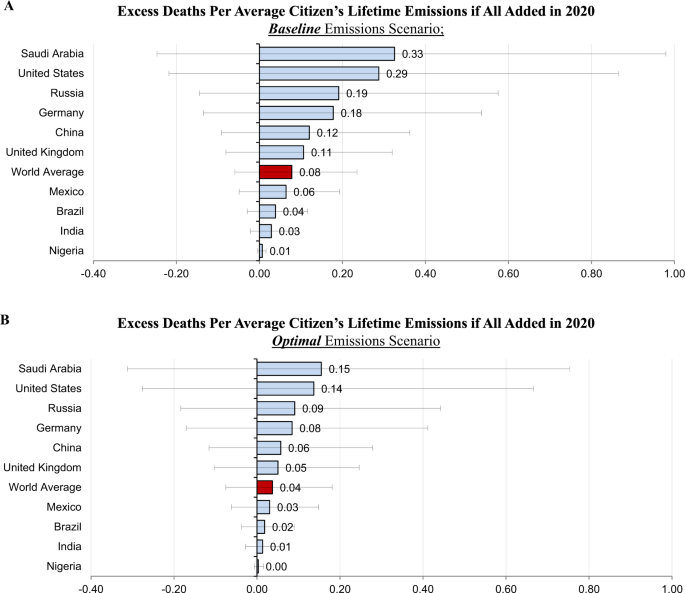
Australian heatwave
It's been hot in the antipodes this month, but it was preceded by some of the coldest January temps ever. Just normal stuff!
Ahead of an exceptional heat wave, SE Australia this morning was very chilly In Particular the Tasmanian King Island dropped to 2.7C ,its January lowest temperature on record ‼️Extreme dangerous heat from tomorrow in SA,NSW and VIC with peaks of 46/49C until the end of the month
— Extreme Temperatures Around the World (@extremetemps.bsky.social) 2026-01-23T11:20:30.453Z
Anyway I didn't get a screenshot of the absolute peak (I was too busy focussing on escaping it) but it was bloody hot for a while there.
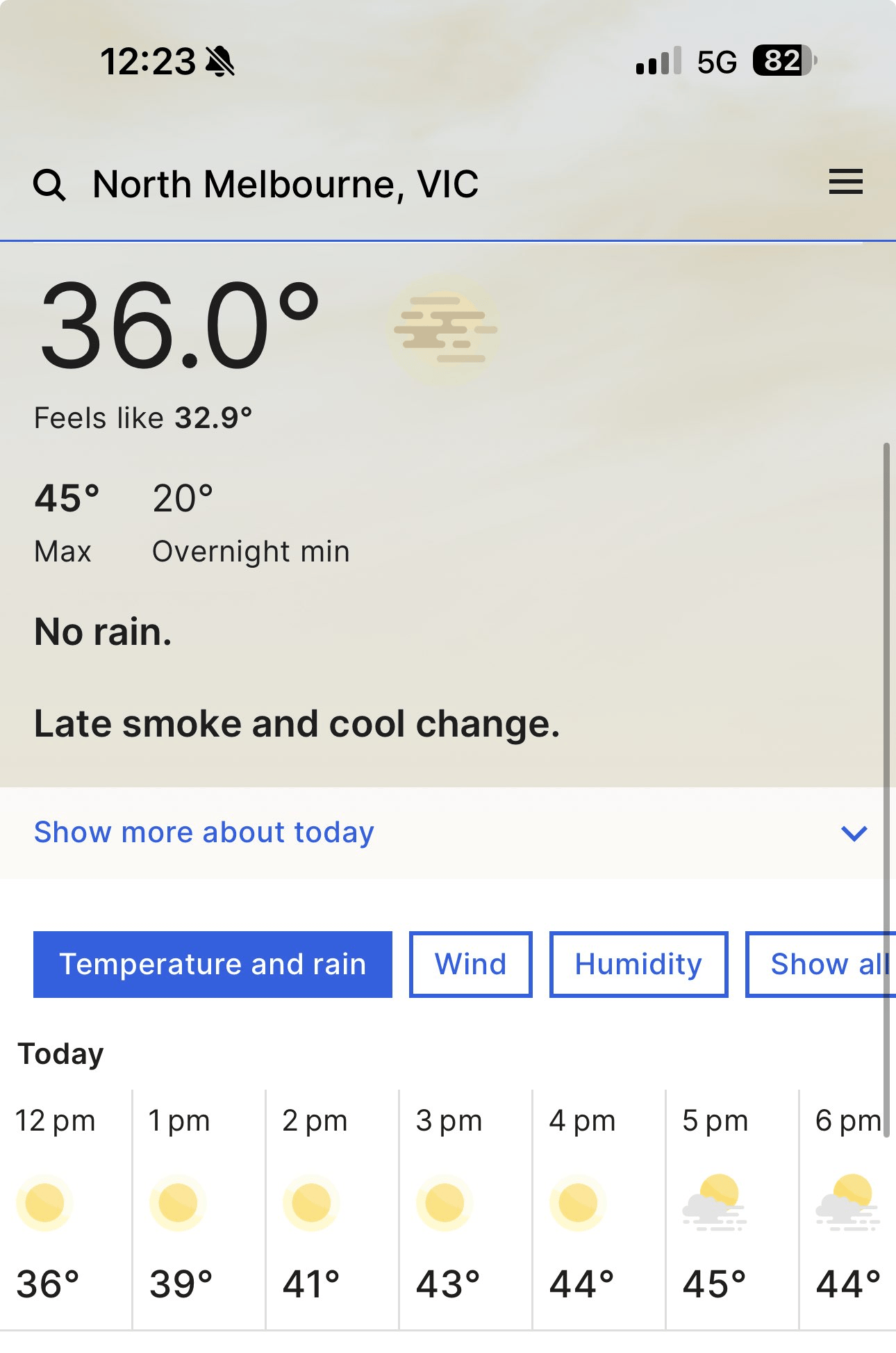
For the non-metric temperature users, that's a peak of 113 in made-up Fahrenheit units. Hope you stay cool (or warm?) as the situation demands!
Next time – perhaps unwisely, I hope to share some possible predictions for the games/sustainability year ahead. Keep your eyes on your inbox for that.