Did PC gaming emissions grow in 2025 – and is Nvidia to blame?


One of my most-read GTG pieces of 2025 was hot out the gates – published in the very first week of January. In it, I asked “What is going on with Nvidia GPUs and PC gaming emissions” and I looked at the eye-watering power consumption of Nvidia’s most cutting-edge graphics cards. Comparing Nvidia’s then-brand-new RTX 5000 series GPUs to the same models of previous generations showed an inconsistent but distinctly upward trend in power consumption over the generations. The trend was particularly pronounced in the ultra-high-end flagship cards of each:
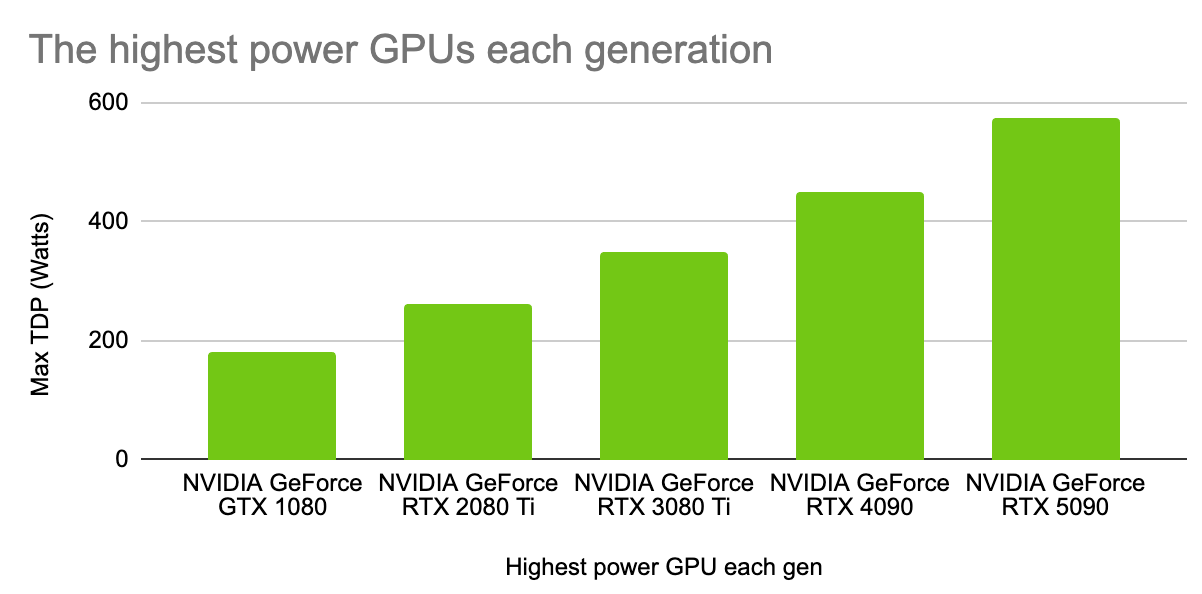
As a result, I concluded that from a sustainability perspective, the picture was not looking great: “all signs are pointing to another year of increasing emissions, increasing energy demand, increasing fossil fuel use.” Well, that year is now behind us, and we can check in again to see what effect the new generation of cards has had. It’s time to check in with the single best data source out there about PC gaming hardware – the Steam hardware survey.
That means it’s time to crack out the same oldGlorious Spreadsheet! Last years one still contained December 2024 GPU data (which I tried cleaning up a bit – more on that in a moment), and to which I have now also added December 2025 Steam GPU data. Now time for a caveat – while I was working on this sheet, at some point today I realised that there must be some an error in the Dec 2024 data. The percentages add up to more than 100 – which can’t be right. I’ve checked different versions from the history of the Google sheet itself, but they all seem to have the same issue – so it seems to appear as soon as the data is imported. It’s over a year since I copy+pasted it from Steam, and last time I was just looking at a portion of the data, so I didn’t notice. This time, I started off by trying to be more comprehensive and add up all the GPUs and their power metrics, which is where it came unstuck. I can only think of two explanations: the first, is if some sort of rounding error is happening, but the percentages included are to two decimal places, so I don’t know how it could end up adding so much. The other explanation I thought of is If I selected too much of the data from the Steam page, and accidentally included data from both the “All video cards” section, and the “Direct X 12 GPUs” – which are separate lists with their own percentages, but that would mean doubling up on some GPUs, and there are no duplicate rows! So your guess is as good as mine. It thoroughly stumped me, and I don’t have the time or programming chops to use this GitHub project that allegedly archives all the steam data.
So instead of using the full Dec 2024 steam GPU data, I’m going to use partial data, which I have from March 2025 (though it was collected in July, it goes back to March) – and it’s made up of just graphics cards that were over 1% of the Steam user base, so its not as comprehensive as if we used the full list, but I think it’ll still illustrate what’s happened relatively well. I’ll also confine (most of) the analysis of the Dec 2025 data to just cards that are >1% in the hardware survey to match. The total percentage of all steam GPUs that have >1% representation across the steam user base barely shifted between March and December (it was 61% in March, and 61.67% in December). So we’re are least comparing apples with apples here.
Steam doesn’t tell us the total number of each GPU, or even really the total number of Steam users. What it gives us is the percentage that each GPU makes up of the total Steam user base - so we’re only ever comparing relative prominence over time, and across a non-stable (i.e. growing) user base, which complicates things a little. But from these percentages, and combined with our database of GPU TDPs we can calculate things like a weighted average power level of Steam users GPUs and note the change from March to December in 2025.
breakout box
A weighted average in this context just means that if there’s more users then their GPU power level is counts for more in the average, and vice versa. It’s like how assignments can be worth different percentages of an overall course final grade, and the results are weighted. Just in this case it’s combined power TDPs for each GPU and its prominence across the user base.
In March 2025, the weighted average TDP of Steam users GPUs was 152 Watts. By December 2025, that number had jumped to 164 watts. The range of TDPs represented in the March 1% sample is 15 Watts to 350 Watts, and the range in December was also very similar – 15 watts to 360 Watts.
In both samples, Intel UHD graphics (15 watts) is the lowest power GPU. In March the highest power card in the sample was the NVIDIA GeForce RTX 3080 (350 W). By December, the highest power card in the 1% sample is the NVIDIA GeForce RTX 5080 (360 W). That GPU, incidentally, only just reached the top 1% of cards in November.
Lastly, the total percentage of GPUs that are above 250 Watts shifted dramatically between March and December, going from 4.25% to 12.68%. My rule of thumb for considering a GPU high power is when it alone is using more power than a PS5! So that sticks out like a sore thumb.
So how do we sum this all up? What are the findings? First, I think the most significant figure is the weighed average TDP – that’s what we would use if we wanted to sum for the expected power consumption across the entire steam user base. This alone is enough to pretty convincingly conclude that the Steam user base is very likely to be using more power in 2025 than in 2024. Jumping the weighted average by over ten watts (even in our 1% constrained samples) is a pretty substantial shift – remember we are talking about millions upon millions of hours of gaming in a year here, adding up to a seriously substantial amount of power. I estimated it at 1.85 Terrawatt hours of power a year, back in November – and that was before accounting for this shift.
The number of Nvidia RTX 5000 series cards in the March sample was precisely zero. Though by June, the RTX 5080 was knocking on the doors of 1% (0.99% precisely!). Cut to December 2025, and we now have five RTX 5000s in the top 1% sample:
- NVIDIA GeForce RTX 5070 (300 W) @ 2.41%
- NVIDIA GeForce RTX 5060 (250 W) @ 1.78%
- NVIDIA GeForce RTX 5060 Ti (180 W) @ 1.32%
- NVIDIA GeForce RTX 5070 Ti (300 W) @ 1.26%
- NVIDIA GeForce RTX 5080 (360 W) @ 1.13%
There we have it – Nvidia’s latest and greatest high-power GPUs have been a big enough driver of increased power that they have quadrupled the number of high power GPUs in 2025, and pushed up the weighted average power of the Steam user base. A lot of upgrading happened last year! Looks like my fears from back in January were sadly right. And as we know, because the world is still very much powered by fossil energy, higher energy use means higher CO2 emissions.
Let's summarise some of the above in table form:
| Metric | March 2025 | Dec 2025 |
|---|---|---|
| Weighted Average TDP (Watts) | 152 | 164 |
| 1% card coverage (of total HW) | 61% | 61.67% |
| Min-Max TDP (Watts) | 15-350 | 15-360 |
| GPUs >250 watts | 4.25% | 12.86% |
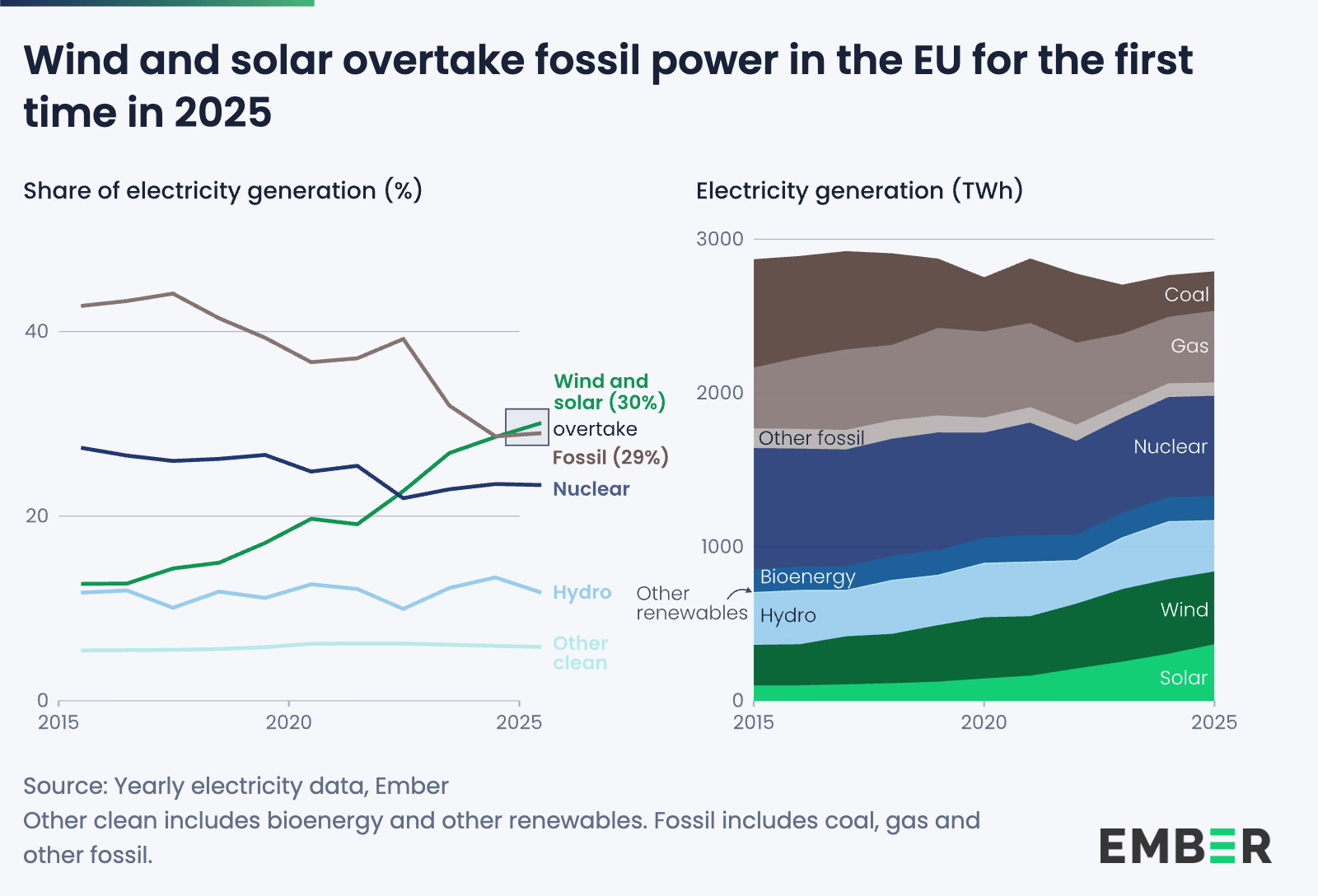
Are there any countervailing forces that might be working against this trend? Yes, though they are, quite frankly, still nascent. First, is the global renewable electricity buildout – it's happening extremely unevenly, but it is proceeding. In Europe last year, wind and solar overtook fossil fuel power sources for the first time. One day – not today, not soon enough – I do believe that we will have enough renewable electricity to no longer need to worry about high power. But we're not there yet, and lots of the world is still very far off.
Secondly, there is energy efficiency in games. This is, as far as I can see, about the only thing working directly against the increase in power from new gaming hardware – and it’s all happening on the software side. It’s eco modes in menus, and other optimisations like we heard Torbjörn Söderman talk about in our Energy Efficiency meetup in December.
This talk still blows my mind, to be honest. And with these new cards out in the wild its going to be even more important to the PC user experience to optimise so that games that don't need to are not constantly melting them. It just makes so much sense.
But we’re going to need to double, triple, even quadruple our efforts in this respect if we are going to make a real dent. We are also going to need to keep thinking about ways to disentangle ourselves from the perpetual upgrade cycle, and the unconstrained more and more and more of game graphics. I'm a broken record on this, I know, but it's only because it's true.
I wish I had better news to deliver – but it’s important to recognise the direction of travel. Metaphorically, PC gaming is still headed full speed the wrong way down the motorway. The game developers, associations and Universities that make up the SGA are all trying to turn it around – please join us.