Which Steam games caused the most download emissions in 2025?


Two things can be true simultaneously:
1) Digital downloads are by far better for the environment than the physical media alternative; shipping discs, cartridges, and plastic cases around the world, and
2) Downloading games still involves the release of some greenhouse gas emissions, until such a time as data centre growth stabilises and the world’s electricity system becomes fully fossil-free.
So, with these two truths in mind, the obvious question that follows is just how many tonnes of CO2 are digital downloads from the games industry causing? This has been a question of some contention for a few years, particularly since the energy consumption of transferring 1 gigabyte of data across the internet had been in what seemed like free-fall. As I showed mid-last year, however, the rate of data transfer energy efficiency has slowed dramatically – it’s simply not possible for it to be halving in the way that it did in the first two decades of this century. At least, not based on the two or three countries where we have reliable public sustainability disclosures from backbone internet operators, where the data transfer energy efficiency gains have slowed dramatically.
The original digital distribution platform for games is Steam, and millions of games were sold on the platform in 2025. A couple of public websites exist to track and estimate these sales numbers, and so with these, we can start to approach an approximation of the emissions from all those game downloads.
I’ve adapted a version of the SGA Standard Scope 3.9 “downstream transport and distribution” spreadsheet for this calculation, which takes as input variables for each game:
- A location that downloads happen in (i.e. the country)
- An emissions factor for the electricity consumed in that country
- The total number of downloads that happened in that country
- The file size of the game depot (Steam’s term for the packed files of the game – these can be smaller than the installed file size of the game)
Then, there are two fixed assumptions, the same for every game:
1) The energy intensity of the transmission network: 0.023 kWh/GB – it’s a bit of an old figure, and ideally we would also have a different figure for each country, but alas! Not possible for now, as far as I know.
2) The energy intensity of the server that has to retrieve and send the data to players: 0.277 kWh/GB – this, admittedly, might be quite a bit high, as it’s an estimate based on global data centre energy consumption and total data processed in DCs. But lacking specific data from Steam, it’s the closest we have to something plausibly usable.
We’re also lacking the specific countries that each download happened in for each game (but game developers with access to their own Steam dashboard do – if you’re interested in doing this, get in touch, or just go ahead and use the SGA S3.9 spreadsheet for yourself), so I’m assigning the location of every game sale to “World” (a global average) so that will have an affect on this analysis.
Also important is SteamDB, from which I gathered depot file size information. I had to manually record the depot size for games, but as there’s over 600 of them I couldn’t do them all, so I’ve focused on the titles with over 1+ million in sales, and a few other big titles that I spotted from a scan of the list, which I suspected might have large depots. Any title I didn’t record the specific file size for, I had to make an assumption. I went with 8GB as a default (maybe a bit high, but it seems plausible), but I also added a dropdown to see what happens to the total when you change this assumption.
But with all that information and those variables established, we can now use the Steam sales data from Steam Spy (which provides an estimated range) and Gamalytic (a very specific sales number) and assume that every sale means 1 download from Steam. Probably not 100% accurate, but close enough.
So what’s the result? Here’s the spreadsheetif you want to see for yourself (and feel free to make a copy and play with the assumptions). Here’s the top 10 games ranked by total GHG emissions, from least to most:
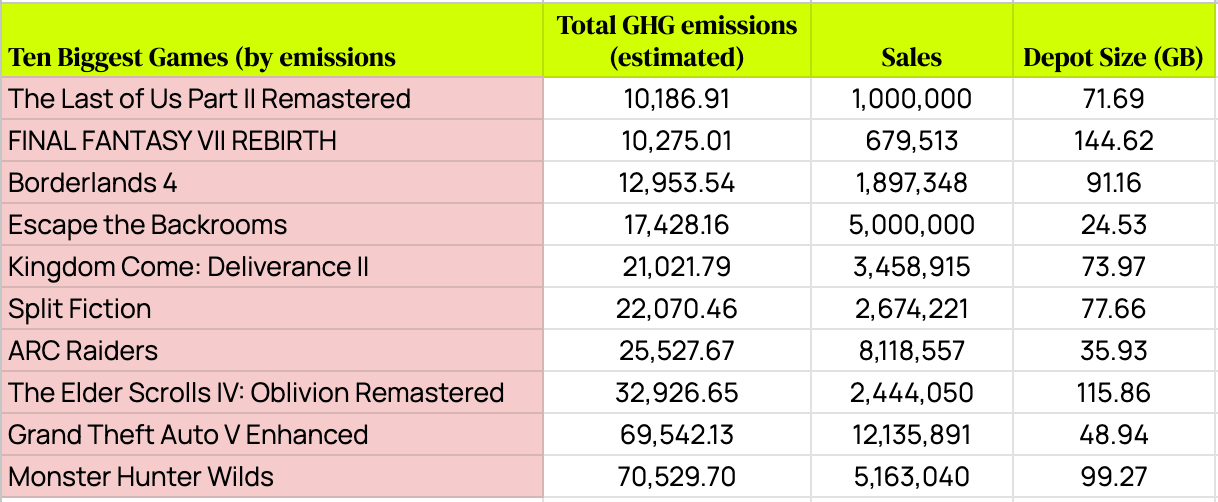
The top 10 games account for about 2/3rds of the total emissions from Steam downloads in 2025, and the number 1 and 2 games – Monster Hunter Wilds (70,000 tonnes of CO2e) and GTA V: Enhanced (69,500 tonnes of CO2e) are alone about 1/3rd of the total. Now, GTA V Enhanced was given out to all existing owners as a free game, so probably it doesn’t represent all real downloads – but how many are is anyone’s guess.
The total from all 600+ games is about 433,000 tonnes of CO2e, which is substantial, and I think supports my position that digital downloads should be measured, disclosed and reduced by game makers.
But what else do we learn from this exercise? First, it may come as no surprise that the two main factors that influence the scale of emissions for game download emissions are total sales and depot file size.
A vast majority of titles in the list, though, don't materially emit a whole lot – for the titles under 1m sales, which I applied a depot size assumption to, I assumed 8GB was a reasonable estimate. Because it’s a lot of titles with a small number of sales, they make up a small portion of the total – but they are meaningful in aggregate. Also, when changing the 8GB assumption to a mere 200MB depot file (i.e. your average 2D indie game), it drops the total by about 1/4, so it's quite sensitive to the average file size of a game depot.
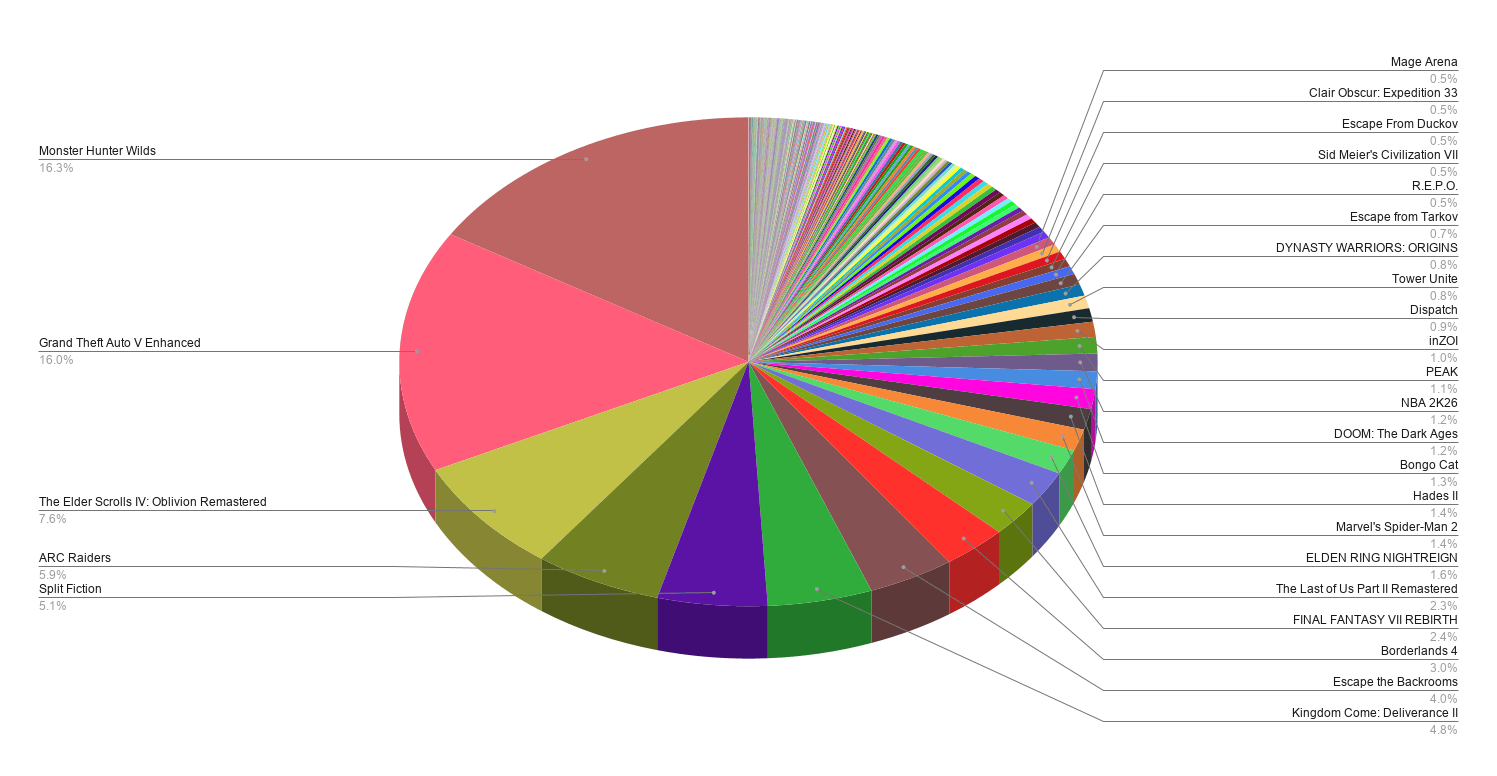
Most of the top-emitting titles, however, are also large games, with depots in the tens to hundreds of gigabytes. But some very, very small indie games do actually still appear in the top 20 titles. Escape the Backrooms (24GB depot; 5m est. downloads) is the highest indie title, but we also see R.E.P.O. (800MB depot; 17.9m est. downloads) in there, as well as PEAK (1.65GB depot; 15.8m est. downloads), proving that even small game files add up when you have a large enough player base. If I were to set a rule of thumb for thresholds at which point a game’s digital downloads might become “material” to a corporate GHG inventory, I would start with the following: whenever sales reach 1 million, and whenever the depot files are 1GB plus. That's quite a low threshold, and lots of game companies that currently aren’t really should be measuring and disclosing these impacts in their inventories.
The other thing that the analysis shows us is that it is possible to reduce impacts from these emissions. If sales numbers and depot sizes are the main feature, clearly no one’s going to advocate limiting the sales of a game, but your depot file size surely can be.
Compare two games that appear in the top 20 list: TES IV: Oblivion remake (115GB depot; 2.4m sales; 33 tCO2e) and ARC Raiders (35.9GB depot; 8.1m sales; 25k tCO2e). They’re both Unreal 5 engine games, and both have some very large and richly detailed environments. For some reason, though, ARC Raiders is far more efficiently compressed or packed for Steam’s depot – meaning that while ARC Raiders might take up 43GB on your drive, the actual download from Steam is only about 36 GB – a 16% reduction. The full TES:IV Oblivion Remake takes 119GB of disk space, but manages to reduce the file size of the Steam download only by a mere 2.7% – it’s a 115GB download still.


I don’t know if there is something fundamentally uncompressable about the Oblivion remake, or conversely, if there’s something particularly optimised about ARC Raiders, but the difference is pretty stark. If ARC Raiders were as unoptimized for efficient depot file size, by my guess, it would be an extra 4000 tonnes of CO2e from downloads.
And remember, this is just a calculation for the initial download from the Steam servers based solely on sales numbers. Think about how many updates some of these games get, and how big some of those updates can be. ARC Raiders gets an update almost every month (which is great!) but they can be as big as several gigabytes each time. No wonder Steam released a video showing how to make more efficient Depots and packs so that players don’t have to download so much each time there’s an update. They will have meaningful costs associated with all that server usage.
All those downloads, updates and other data transfers from the Steam servers are things that Valve pays for – and which gives them something more to claim to be providing as a meaningful service to game developers who use the Steam platform. They too are under pressure, much like Apple and Google via the Epic/Fortnite case, to justify their exorbitant 30% cut, and this is another thing they can point to. Would a “user pays” system that tracked actual data sent across the Steam network deliver an incentive to more efficiently pack their game files, and reduce Valve’s foundation for their cut? I’m personally quite partial to the idea that digital infrastructure and platforms are the utilities of the 21st century, and should probably be regulated as such – but I’m just thinking out loud here.
Last, but not least, here is a chart of ALL the titles and their GHG footprints – you can pretty clearly see the ones that matter the most to overall emissions, and the dominance of a few large titles, and how quickly the smaller ones shrink below being 1% of all Steam download emissions.
So, now we know what sort of impact game downloads can have – what I want to see next is a game developer or publisher (preferably from one of the games in this list, but literally anyone with a Steam game can do it!) calculating their location-based download emissions. It’s super easy, just log into Steam, go to the Downloads tab, and export the CSV. There’s a tab in the SGA Standard Scope 3.9 Downstream Transport and Distribution emissions data input sheet that is specifically for Steam downloads, and it will do the calculations for you.
Then, once you’ve got it, get in touch! I would love to see how it differs from a single world-average – what could we learn about how important it is to pack downloads efficiently by seeing where in the world your players are, and what sort of emissions they’re creating through downloads? Only time will tell.
The average non-big-tech game industry corporate GHG inventory total last year was only 300k tonnes of CO2e. Capcom's corporate total for its emissions for its' most recent financial year with data (the year ending March 2025) was only around 100,000 tonnes. The downloads alone from Monster Hunter Wilds last year are, if my calculations are close to correct, increase that by 67%. Just one game! A very successful game, so it's a good problem to have, but it's a substantial amount that they, in some sense, share a responsibility for.
For companies that are submitting or planning to submit targets to validation orgs like the Science-Based Targets initiative, these aren't the sort of small, non-material amounts that can just be left off the board. Big success means big impacts – even for small games, as we saw with REPO and PEAK.
Lastly, what variables would need to change dramatically to change the underlying dynamics of this analysis? What might undermine this argument that "digital game downloads are material and should be measured and disclosed"? For one, if Steam revealed tomorrow their data centres' average data transfer energy intensity, and that value was 2 or more magnitudes smaller than the existing one (mentioned at top), that would shift the total by the same order of magnitude – changing the total from the 100's of thousands of tCO2e per annum and into the tens or dozens. At that point, you could say: "Actually, this is not a big deal". While all emissions need to come down, of course, if Steam downloads were only 40 tonnes of CO2e per annum, this isn't where we should put our time and effort. But for that to be true it would require infrastructure that would retrieve and transmit on average 1GB of data for less than 2.7 Watts of electricity (compared to 277 watts from the current estimate above). And that figure also needs to include all the DC energy used in overheads like cooling, lighting, and networking. These overheads are measured in power-usage effectiveness (PUE) multipliers, and they'd need to be achieving the sort of numbers that only the hyperscalers have managed, and at great cost.
Is that possible? Is that plausible for the entirety of Steam's global infrastructure? I'm genuinely not sure – maybe it is. I would like to be wrong! A super-efficient ARM chip like the one in my M2 MacBook Air might be able to approach something like it, but it's far from guaranteed. To be sure, we would first need a lot more information to be divulged by Valve, the notoriously secretive and private company. Until then, I await to be convinced! New research may always come out to prove me wrong.
But in the meantime, I'll be recommend that the most successful game companies and the most successful game makers start to take a closer look at the downloads of their games. I'll be keeping an eye out for any new disclosures this year that might point in one direction or another, and any more information I can see about the efficient packing of game files. Seems worth it, from here, as we march headlong into the great climate unknown.
Thanks for reading this week's edition of Greening the Games Industry! Please accept my apologies for the longer stretches between posts, and I hope you still find every issue worth your time.