Zoonotic diseases & hope in shared struggle

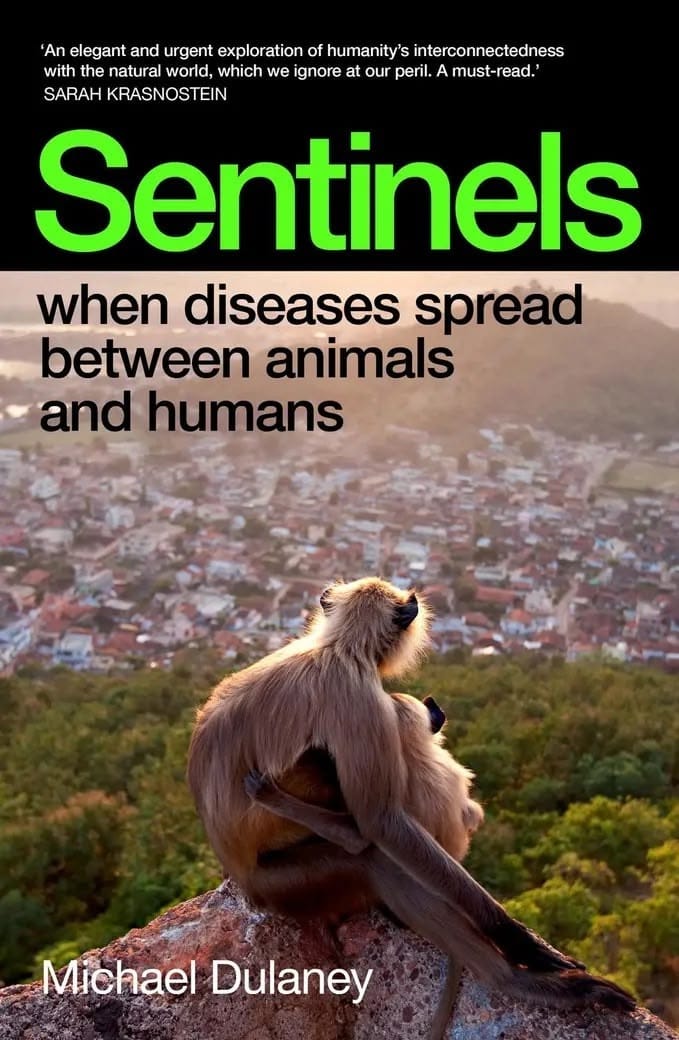
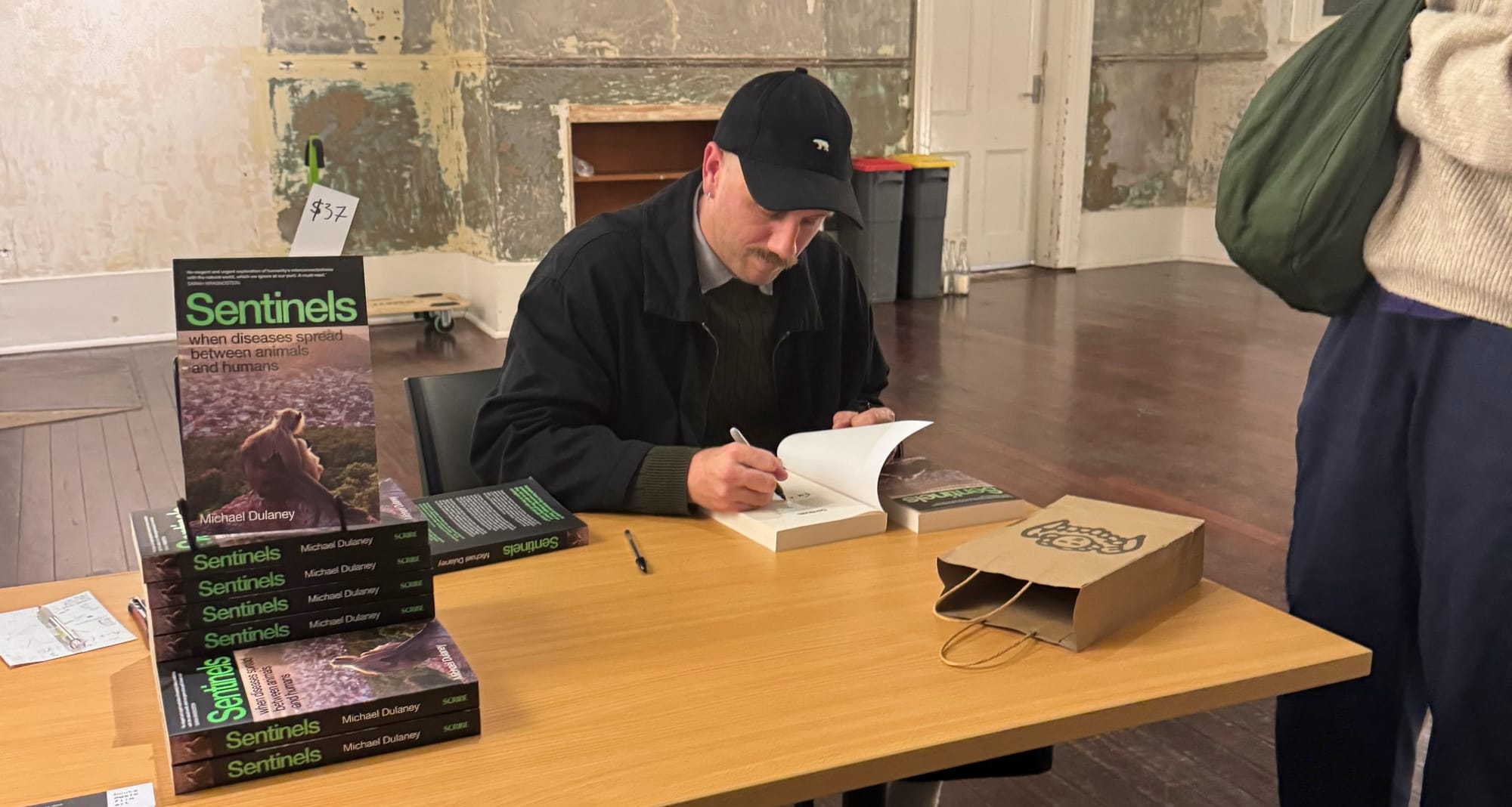
I went to a book launch last night for an exciting new manuscript from a friend of mine, environmental journalist Michael Dulaney. It’s about zoonotic diseases, and the interface between human and nonhuman worlds, and it feels very timely given the new (and often deadly) bird flu strain currently spreading through Australia and many parts of the world. I have only just scratched the surface of what promises to be a rich and challenging book, but the introduction coupled with the reading that Mike shared at the event gives me confidence that many of the readers of this newsletter would probably appreciate it.
In the preface, Dulaney acknowledges the challenge he faced in making such a depressing topic accessible to readers – particularly in light of what seems to be our collective burn-out on COVID. It's a communication challenge I struggle with myself. It’s been on my mind a lot lately, after the fires in France, Spain, and Canada, and seeing the likelihood that this year will be the strongest El Niño on record. But I have also been encouraged by some initial responses to these disasters, like the joint statement issued by the Spanish and UK governments resolving to continue the fight against climate change. In Sentinels, Dulaney calibrates his writing against our current viral fatigue, and finds a hopeful core in the fact that what we are describing is a single, shared struggle:
Infectious disease is a morbid topic, even more so in the aftermath of a pandemic. But it is also fascinating, and can reveal unexpected or overlooked histories, as well as much about the way that societies are organised. This puts any writer on this subject in a tough position. Most people, we are told, want to read good news. They are fatigued by climate coverage and ecological collapse. This, at times, feels overwhelming. Here is one thing I can say with certainty: the challenges facing us in overcoming the climate crisis are the same as those facing us in this book. There are no pharmaceutical fixes to a planetary health problem. In a way, this is the good news-the struggle for one is the struggle for all.
(Sentinels, p.6)
It's worth keeping in mind as we toil away in our own little corner or patch, striving for small improvements to methods, marginal reductions in planet-wrecking greenhouse gas emissions, or tiny improvements to energy efficiency. We are all connected by the same struggle.
Dulaney’s perspective in this passage reminded me of another, similar sentiment from a pair of great thinkers – Geoff Mann and Joel Wainwright – and the conclusion of their book Climate Leviathan. In their 2018 work, they lay out the two dimensions on which political responses to climate change are able to unfold – falling somewhere along axes of capitalist/anticapitalist, and planetary sovereign (think: technocratic global regimes like the Paris Agreement, or in future, certain countries deciding unilaterally to begin solar radiation modification)/anti-planetary sovereignty (i.e. more democratic, locally decided climate action).
In the final chapter of their book, they lay out the bleak conjuncture which we still face nearly a decade later:
One of the most profound paradoxes of climate justice is that our work is oriented toward an open, just future for those to come, particularly the descendants of the world's less powerful, but this future is so undeniably bleak (and the world's present political arrangements so undemocratic) that any informed, rational response is likely to pull us toward Climate Leviathan, because the further consolidation and expansion of extant power structures would seem to be the only structures of scale, scope, and authority even close to adequate to the challenge of climate change.
(Climate Leviathan, p.173)
Climate Leviathan, in their telling, is a description of climate responses that take forms that reproduce existing capitalist modes of production, and which aims for top-down, less or even anti-democratic approaches (even if in the name of climate action). Mann and Wainwright’s favoured alternative, they describe as Climate X:
we might say that Climate X is a world that has defeated the emergent Climate Leviathan and its compulsion toward planetary sovereignty, while also transcending capitalism. This is obviously a tall order, to put it mildly. But only in a world that is no longer organized by capitalist value, and in which sovereignty has become so deformed that the political can no longer be defined by the nation-state's sovereign exception, is it possible to imagine a just response to climate change. This general schema gives us some broad sense of direction, and a few indicators by which to identify and measure progress. Support for green Keynesianism, REDD+, climate finance, and the elite politics of adaptation can no longer be priorities. They are distractions, dissipaters of energy for change. The priority must be to organize for a rapid reduction of carbon emissions by collective boycott and strike. Is this utopian-ism? Possibly, but not necessarily. This is Climate X, and whatever form it takes, it has the extraordinary merit attached to that which is absolutely necessary. (Climate Leviathan, p.173)
I love that phrase: the extraordinary merit attached to that which is absolutely necessary. Depending on the mood you catch me in I might give you a different answer as to whether I agree about its necessity.
In any case, I wanted to add a brief note here as well that I wish I had more time to write for this newsletter. Work at the SGA continues at a rapid pace, even as it paradoxically feels glacial at times, or in terms of concrete progress. I have also had less time than usual lately because my partner and I are expecting our first child in the coming weeks. Preparing myself for parenthood has also helped me renew my hope for our planetary future, and I have been thinking a bit about how my generation (millennials) and the zoomers that are coming up after us have a marked focus on environmental responsibility. I hope my yet-to-be-born daughter’s generation can be the ones to deliver on what we have begun to set up, and take it even further and faster.
In the meantime, I’m looking forward to reading my copy of Sentinels, to hear more about the people all around the world with a deep and abiding love and care for animals – from rescuers of flying foxes here in Melbourne, to Indonesian guides with an uncanny knack for finding rare and endangered amphibians for visiting scientists and wildlife tours. It seems like a highly timely book, even if some people might not be ready yet to think about the possibility – or really, the certainty – of another pandemic given the fact that the underlying forces that produced COVID-19 remain entirely unchanged. Did you know that around a billion frogs are traded every year? Most of them from Indonesia. Until last night I had not heard of the return of “trench fever”. It's a disease that was last seen at any scale in the trenches of the First World War, now suddenly return among the growing homeless population in North America and around the world – an irrefutable symptom of the failed housing policies of the past decades. It is basically impossible to catch for anyone with access to dry shelter, and a warm shower.
It’s awful, mind-boggling stuff. The way we treat the world we live in as a bottomless pit for our waste (carbon dioxide), or as an expendable resource for the most thoughtless extractive processes. Increasingly we can add to that, the way that capitalist societies treat humans and animals alike as barely better than expendable. As Dulaney reminds us, this is a shared struggle: from frogs to forests, videogames to the vulnerable, coal mines to coral reefs.
I'll end with a picture of the author signing copies of the book at the launch. You can preorder Sentinels from the publisher Scribe Books here, or try your local book retailer. I really hope the book finds its audience.