Energy Efficient Games in Godot + Ubisoft's annual report + PS5/6 info +AI out the wazoo – GTG Links 76


Some weekend reading (and watching!) for you.
Why you should make energy efficient games
Ashe Foltin (Bold Beetle Games & SGA energy efficiency network coordinator) gives a stellar talk at GodotCon 2026 on how and why to implement energy efficiency in games. Some good questions from the audience at the end too.
What's new in Ubisoft's annual report?
Plenty! Including a full disclosure of the footprint of gameplay from players of Ubisoft games, for the very first time! They've even projected the numbers back to 2020. This is a fantastic development, and something I've been begging the industry to do for years now – so it's great to see the increase in transparency. Ubisoft joins some great company in making these disclosures now.
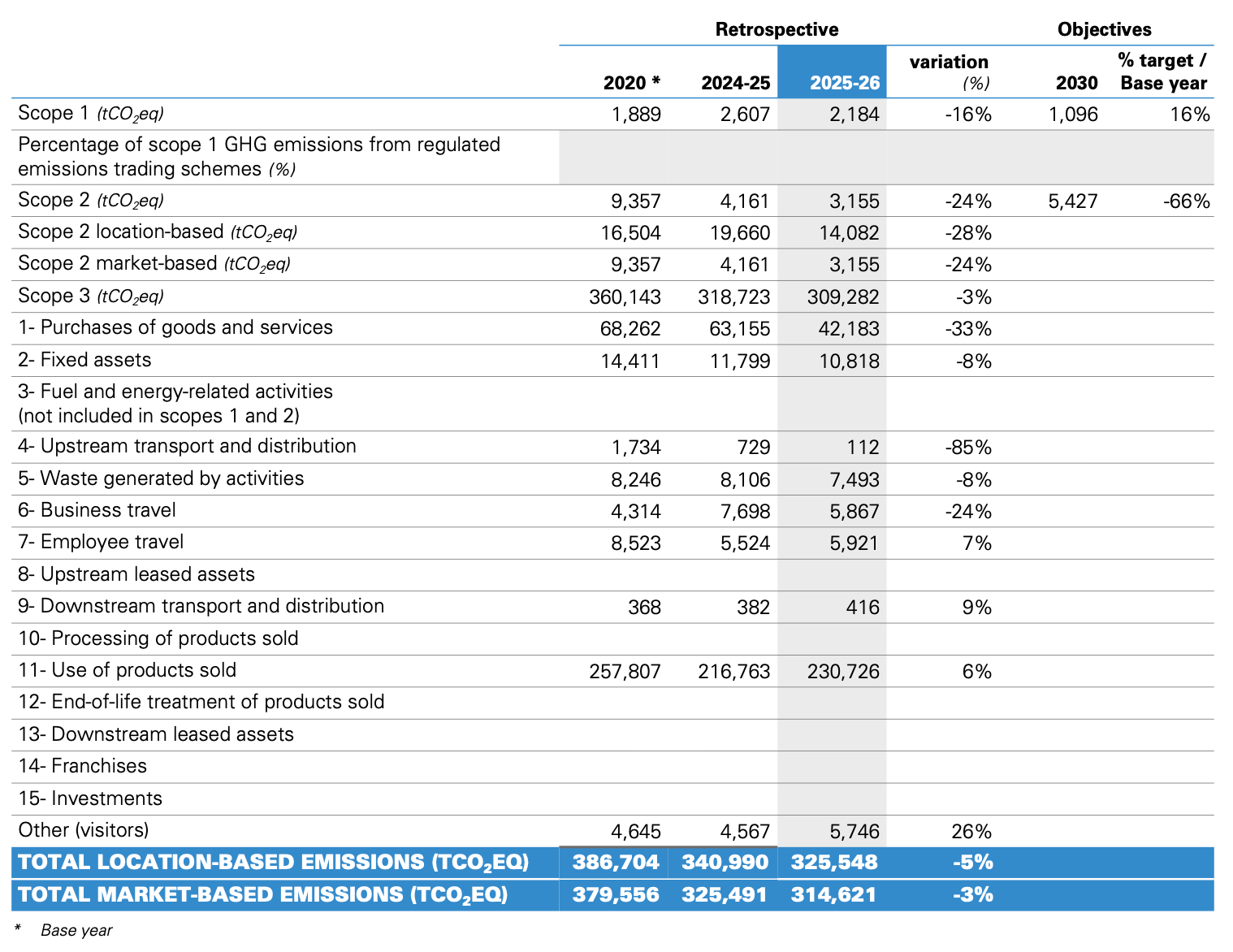
Other top-line observations are that absolute emissions are still on a downward trajectory, though the reorganisation and employee reductions will have been helping here. After correcting 24-25 data with the new S3.11 disclosures, this year Ubisoft is -4% year-on-year, and intensity metrics (headcount/revenue) are mixed due, probably, to the turbulence and layoffs. Renewable power purchasing remains high, at 89% renewable electricity. Lots of other details on the progress of Ubisoft's initiatives like eco modes as well. Plenty for the obsessives to pore over (that's probably just me, isn't it?). Check out the report here. [PDF]
PS5 discs are going the way of the dinosaur
 Sean Hollister
I have very mixed feelings about this because, on the one hand, the plastic burden from discs is real, as is the emissions from transporting them, as I wrote about here and in Digital Games After Climate Change:
 Ben Abraham
On the other hand, as I mentioned in passing in that piece, there are still a host of unresolved problems with the currently quite weak "digital ownership" models at present. Seriously, the digital game ecosystem on consoles sucks, and I think we all know it. The walled garden stifles competition in a way that physical discs does not, prohibits resale of games, and leaves an inordinate amount of power in the hands of the console makers. I don't know what the answer is here, besides something like the concessions that Epic got from Apple and Google, or from the EU's digital markets regulations (though AFAIK they don't cover game consoles – yet?). We still have yet to really confront the power of digital platforms, and I suspect the gaming platforms are a ways down the agenda for most regulatory-intervention-inclined governments.
Speaking of digital markets...
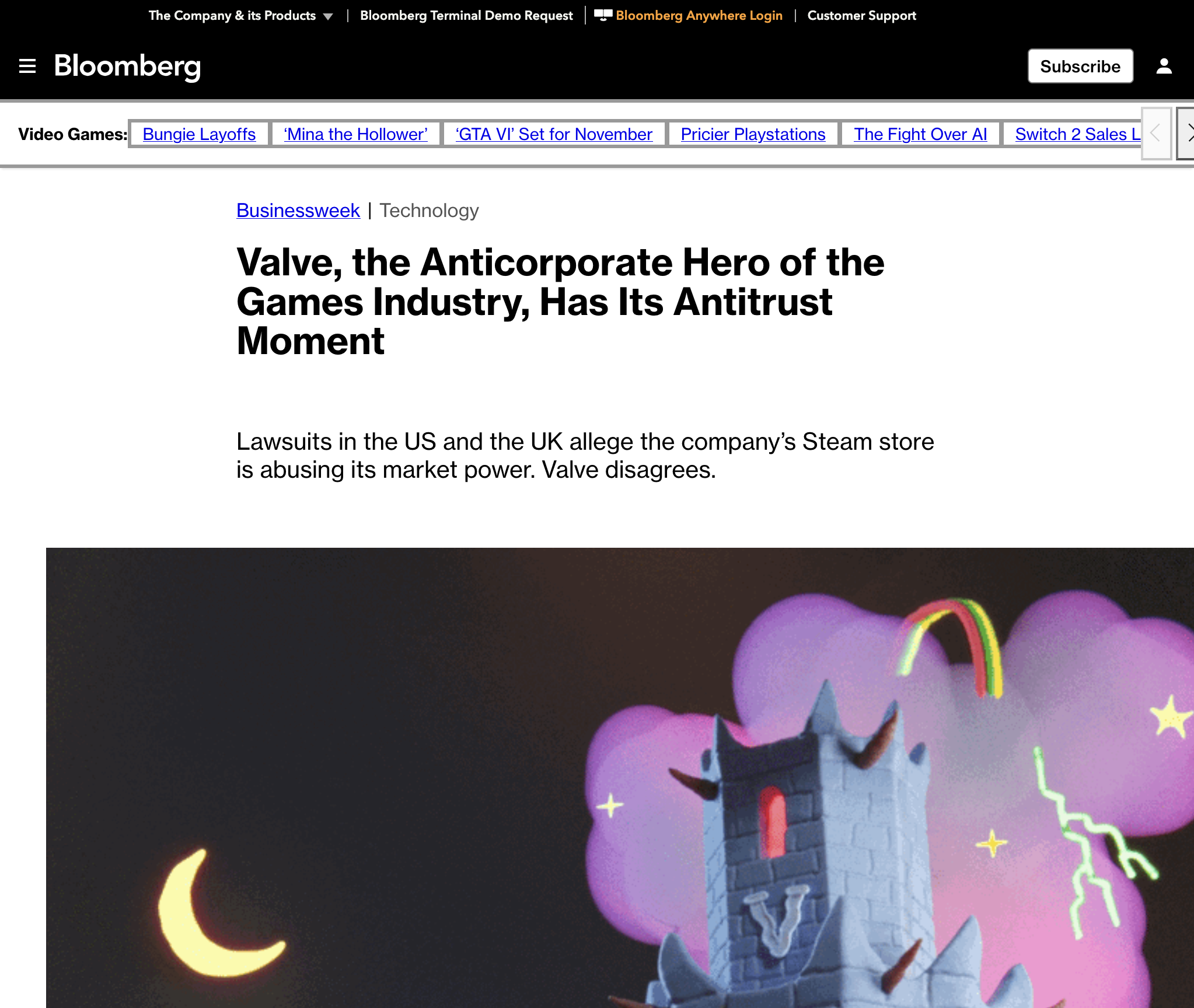
Boomberg did a really interesting profile of Valve recently:
Steam’s user base has grown 60% over the last five years, and 42 million people are logged in at any moment. New data from research company PrivCo Holding Inc. estimates that Valve generated $5.2 billion in revenue in 2025, with a net income of $1.5 billion.
PS6 is going to be expensiveeee
After thirty years of almost constant growth, games seems to be in perpetual crisis. First thanks to the post-covid great "touching grass" moment of 2022- that seems to stubbornly keep on going, and second thanks to the hardware squeeze resulting from the AI bubble. Is this just our new normal?
 Sherif Saed
Gaming Hardware and Conflict Minerals
Speaking of expensive devices: Which gaming companies funded conflict through minerals and manufacturing? Kotaku compiles the annual conflict minerals supply chain disclosures of the games + tech industry.
NVidia RTX Spark is... interesting
Nvidia seems to be trying to do for windows what Apple silicon did got Mac – high performance without the power cost – by shifting to ARM based CPUs.
This will be really interesting to watch over the coming months, particularly since Windows PC power consumption is some of the biggest source of end user emissions. This seems mainly aimed at portable (laptop/handheld) computing – and doesn't seem likely to influence the power use from standalone graphics energy consumption. But if trends continue in that direction, we could be on the cusp of a power saving renaissance? That would be quite welcome, after all the upward pressure from Nvidia’s flagship cards. But we will have to wait and see if it eventuates in an overall PC energy reduction.
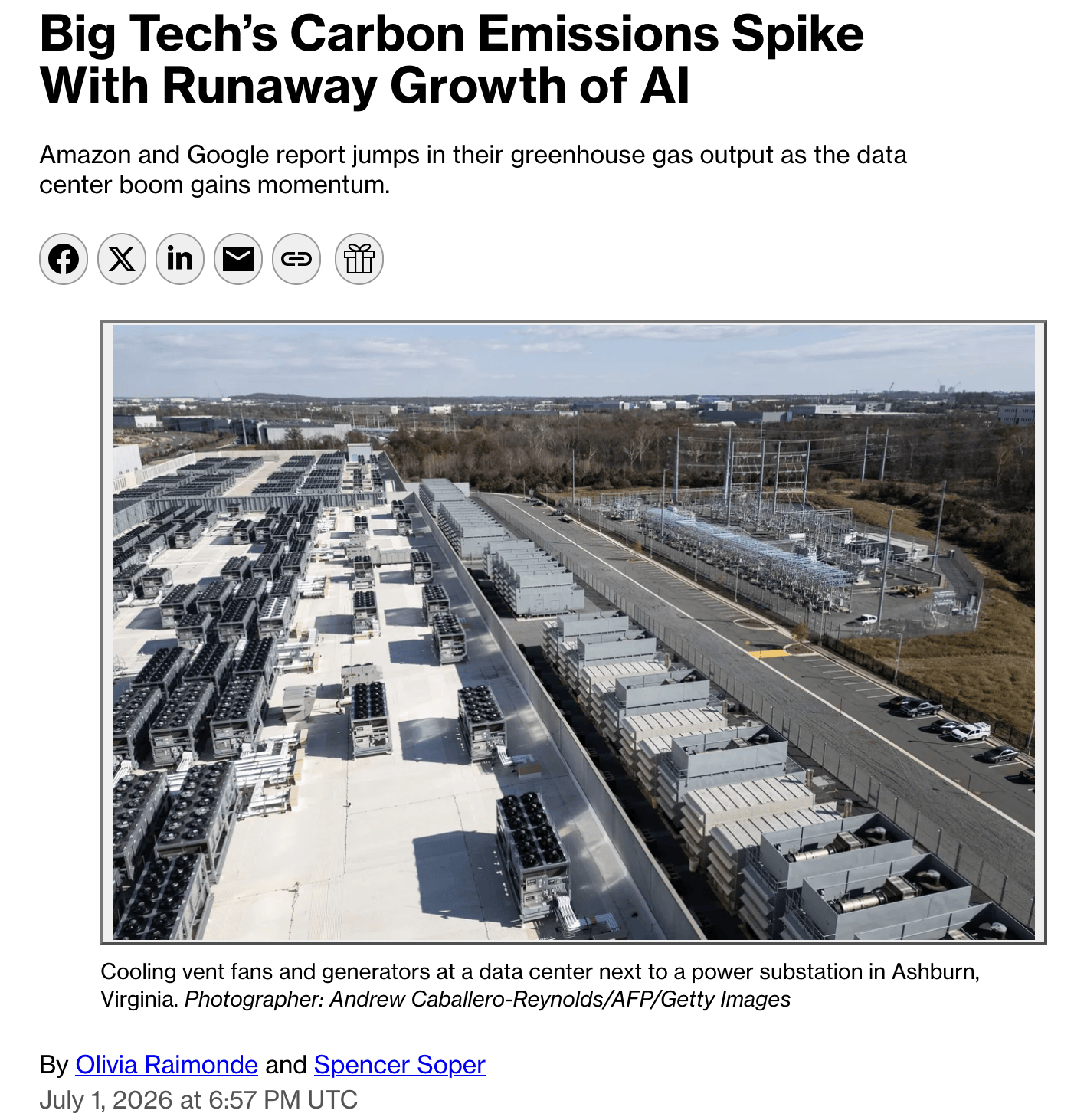
“We’re essentially in a climate crisis and we should not be having emissions growth at all, arguably, and yet the data centers are going in the opposite direction,” said Sasha Luccioni, co-founder and chief scientific officer of Sustainable AI Group, which works to measure and limit the environmental impact of the sector.
Read the full piece on Bloomberg (or elsewhere).
And the UN's latest report on the environmental impacts of AI on energy, water and land use is highly recommended if you want the latest evidence of where the challenges are.


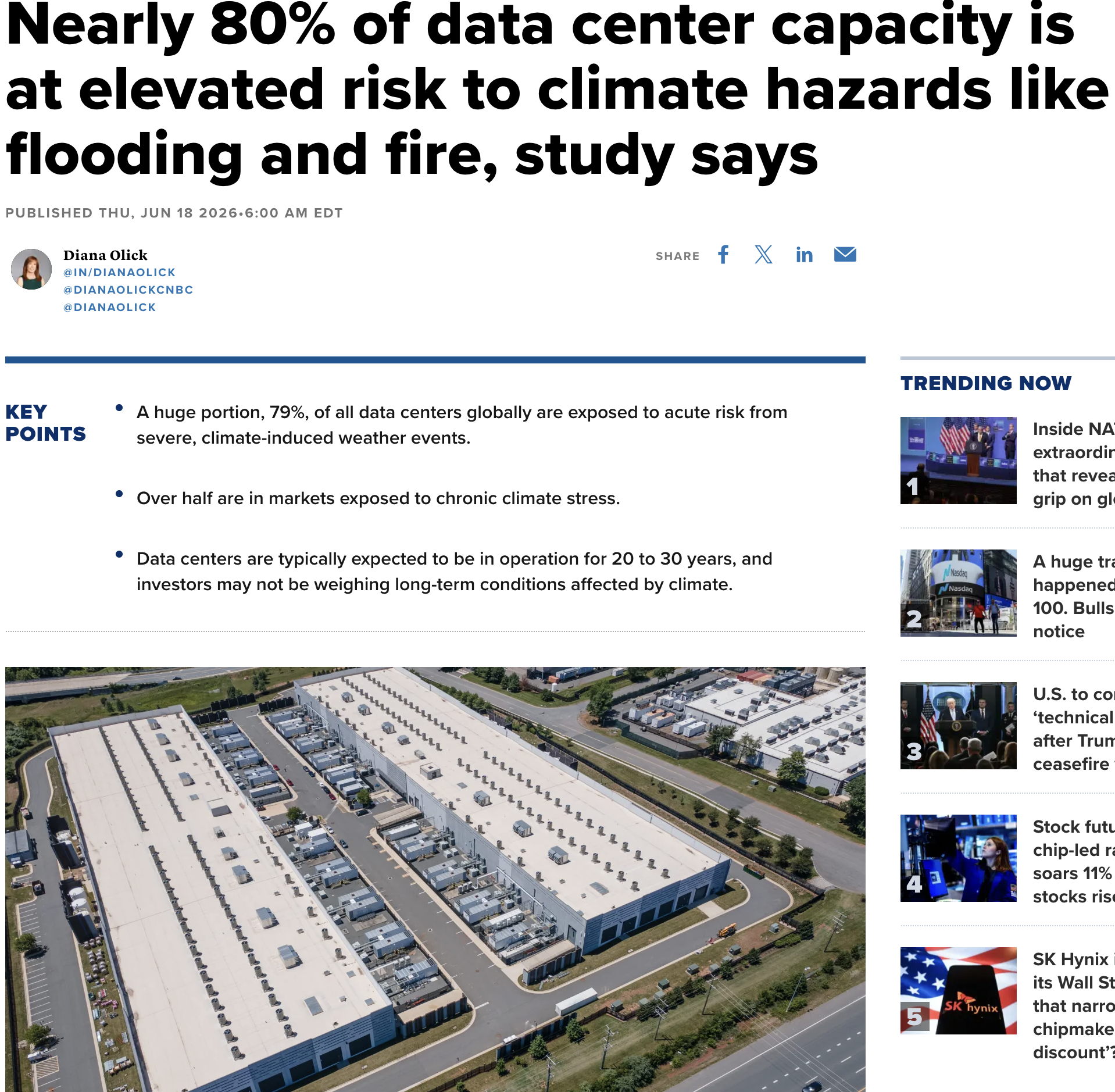
DC exposure to climate risk
via CNBC.
Really great HBR report on the impact of AI on code and software production:
In 2016, Geoffrey Hinton argued that AI would soon replace radiologists, yet demand for radiologists has since surged. The reason, this article argues, is that AI reduced the cost of image analysis while increasing the value of complementary human capabilities: judgment, accountability, and apprenticeship. The same dynamic now applies to software engineering. Although AI can generate code cheaply and quickly, companies risk confusing code production with the broader work of engineering reliable, scalable systems. Unlike radiology, software lacks strong liability structures or professional oversight, making AI-related errors harder to detect and correct. As firms cut senior engineers and shrink apprenticeship pathways, they accumulate “capability debt” and “judgment debt” that may only become visible years later. To avoid dismantling the human expertise that gives AI-generated output value, leaders should implement software provenance tracking, require named human sign-off on AI-generated code, and establish accountability systems that make poor AI governance costly. The central lesson is that AI changes what becomes scarce: not output itself, but accountable human judgment.
 Chengwei Liu and Balázs Kovács
And a post about classifying and routing tasks before they go to a flagship AI model - we have rediscovered the power of non-AI software!
 Navveen Balani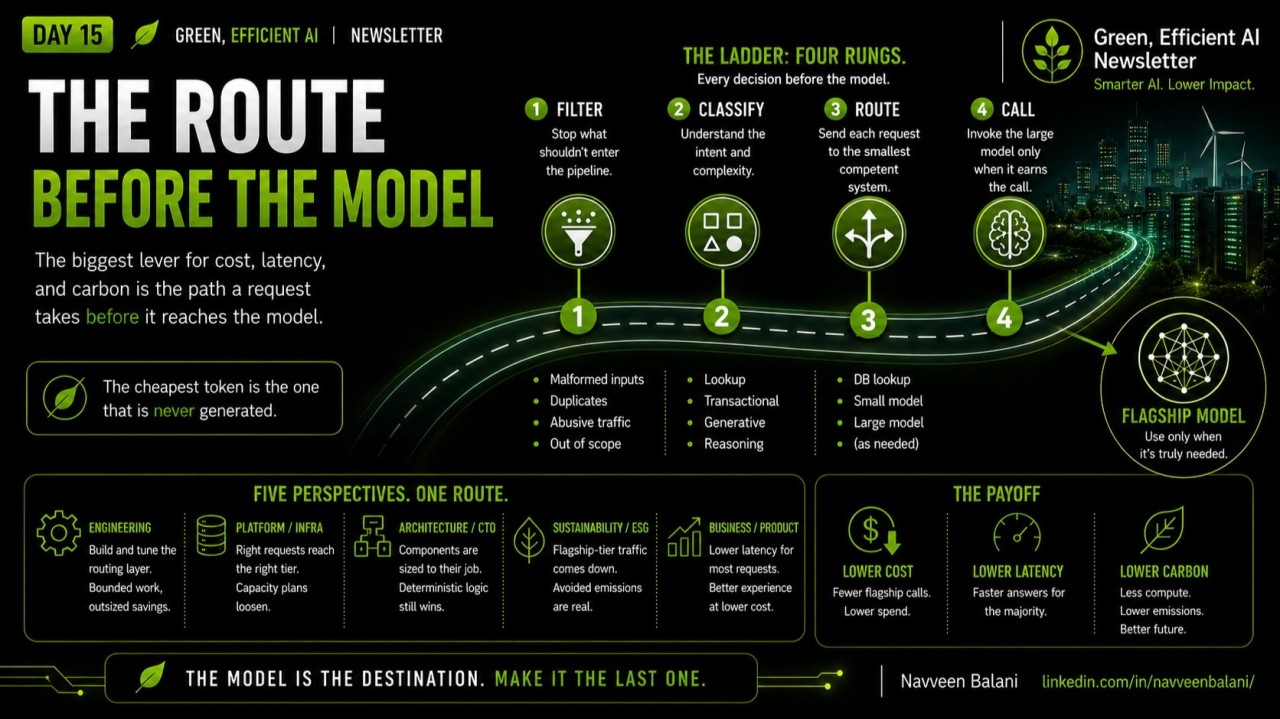
AI Water Use Value Chain
World Resources Institute has started work on a new way to account for and mange risks around water use across three scopes – like Greenhouse Gas Emissions. This looks potentially quite revolutionary.
 Sara Walker
And just in time, the WSJ is reporting on the need to look at this dimension of water use by big tech.
The WSJ report can be found here.
IEA’s new Heat Pump taxonomy looks really quite helpful
It introduces a structured classification framework based on source, sink and product characteristics. Advancing towards a common taxonomy supports cross-country comparability and facilitates international collaboration towards strengthening the evidence base for policy making and industry planning.
The Heat Pump Taxonomy Technology Explorer offers an accessible, interactive way to explore different heat pump types available in the market with fact sheets summarising their technical characteristics, major regional markets and applications.
Neat! Check it out here if you're a nerd like me. 🤓
Thanks for reading Greening the Games Industry – hope you have a great weekend!