Emissions from playing CS2, DoTA2 + duplicate Twitch streams


Hello – I hope you haven’t missed me too much! I’ve been busy and feel like I've been neglecting the newsletter. 🥹 There's been a number of personal things going on, our work at the SGA has been quite hectic (with some cool new partnerships I hope we can announce soon), and my recent writing time has been spent mainly on contributing to a new paper with Mike Hazas & co. from Utrecht University. We have finally (finally!) drawn together the many different estimates and data sources to make some tentative estimates of the total game production ecosystem from hardware to software, distribution, and of course, end users’ and their millions of hours of gameplay. It’s still a work in progress, but I think it’ll be a great resource once it’s ready.
But for this week’s newsletter I wanted to talk about a pair of recently published papers which touch on similar topics (and some we were not able to include) which GTG readers might find compelling. I think both are excellent, thought-provoking pieces in their own ways, and with insights that I am already preparing to use to make the SGA Standard itself better.
The first paper is titled ‘Carbon Footprint of Online Multiplayer Games’ by David Medina, and it looks at the emissions from two major PC games: Counter Strike 2 and DoTA 2. [Here’s an upload of the PDF for those without institutional access]. It applies the guidelines for producing a carbon footprint for products as set out in the ISO 14067 standards, interpreted for digital games, and it goes into some great detail – with figures for the emissions of both PC game hardware manufacturing and electricity use during gameplay. Here’s the chart of results, showing the balance of pre-operational (embodied emissions + downloads) stage vs operational emissions (energy used during gameplay).
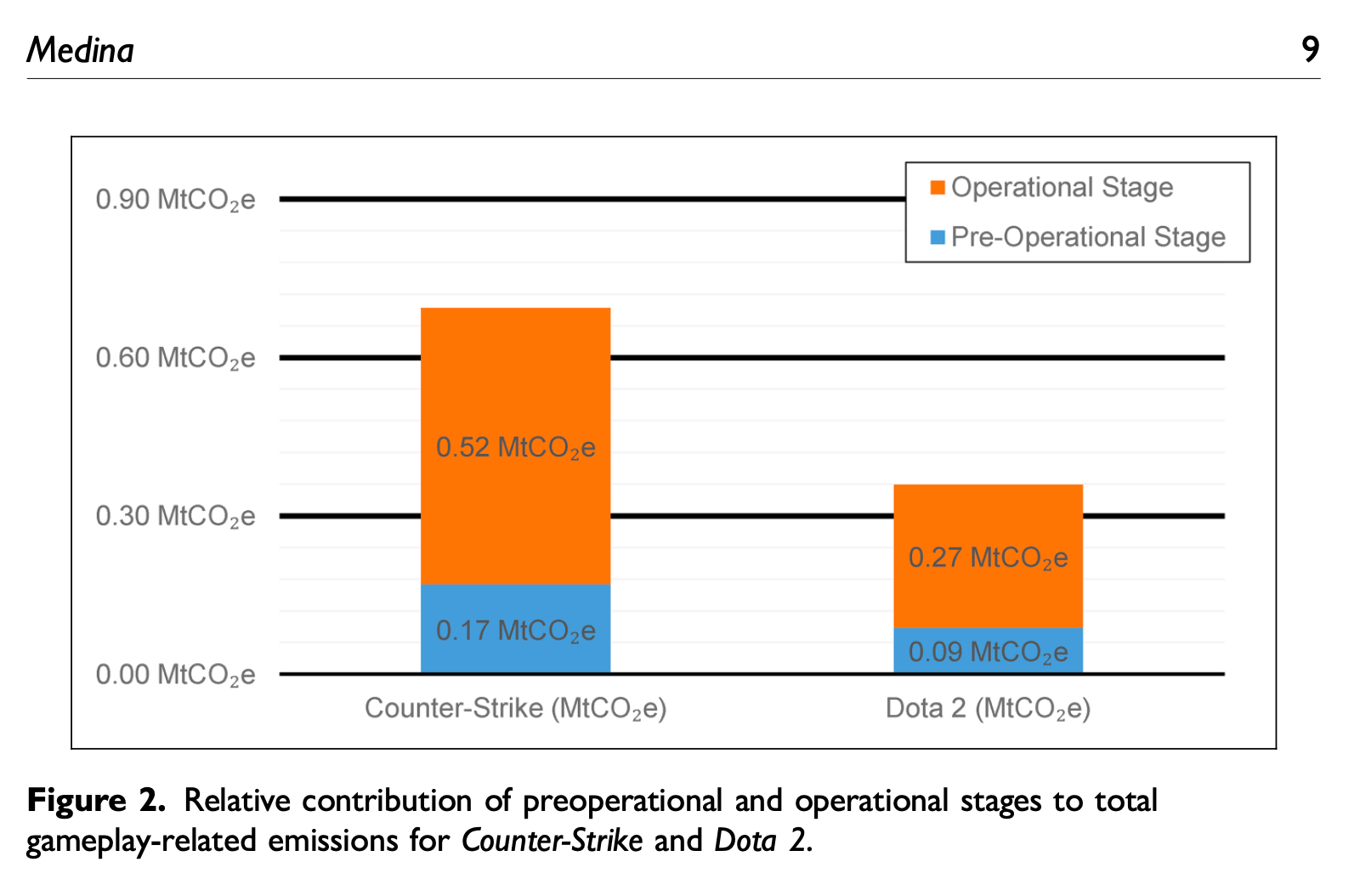
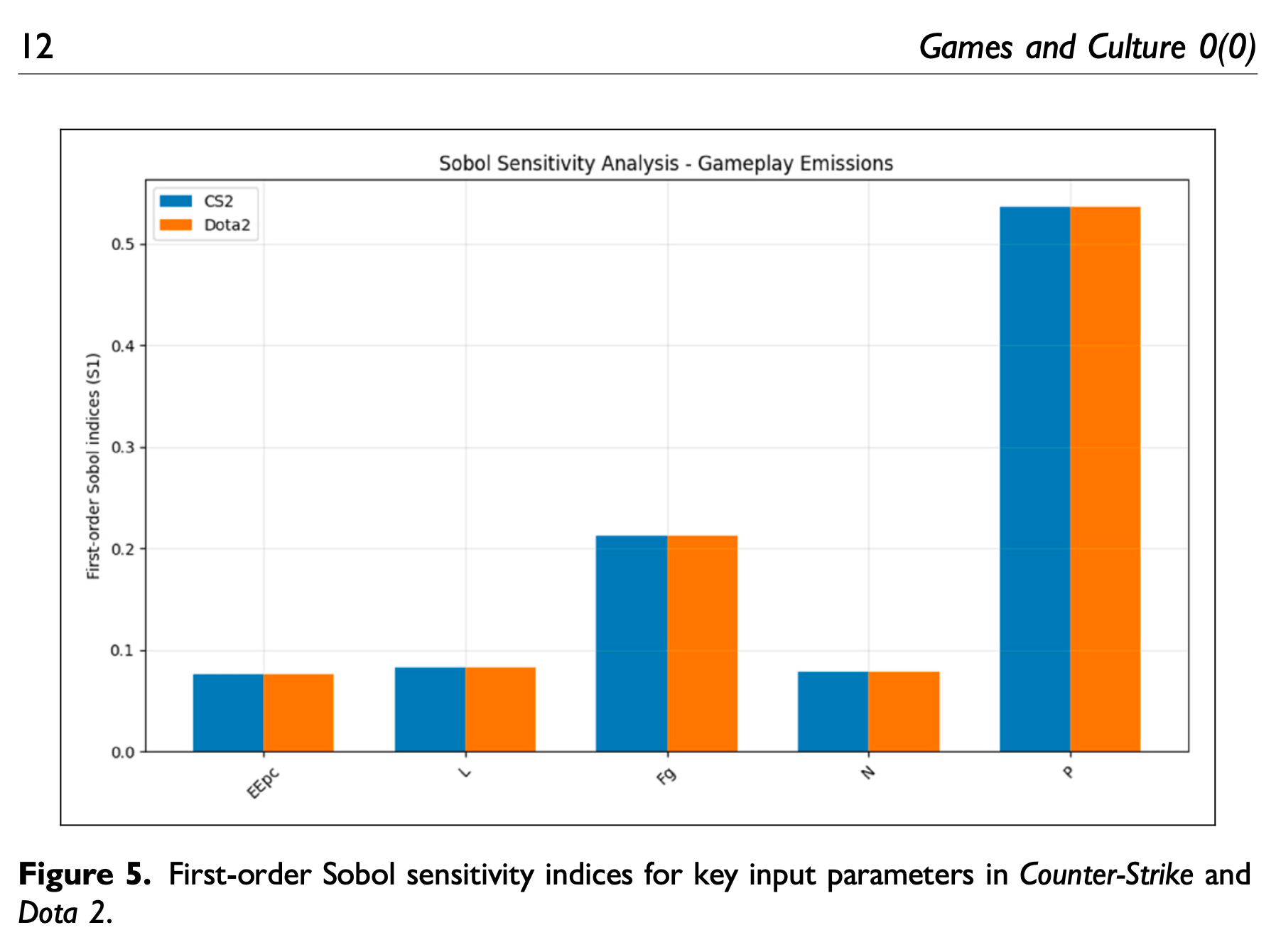
Together, these two massive PC games accounted for about one million tonnes of CO2 in 2024, which matches the order of magnitude I would expect based on my own calculations (I don’t think I’ve shared my full extrapolation based on Steam player data here yet – but I will once the paper I mentioned up top is out). Medina concludes that “the analysis reveals that electricity consumption during gameplay overwhelmingly dominates emissions, accounting for over 75% of the total, while embodied emissions from gaming PC manufacturing contribute roughly one-quarter.” (15) This strikes me as quite strong evidence yet again for the need to focus our efforts on improving the energy efficiency of games, and Medina’s conclusion is backed up by a sensitivity analysis that shows power consumption as the most important factor, determining over half of the total climate impact.
The fact that the world’s leading climate target NGO – the Science-Based Targets initiative doesn’t have any real facility to encourage software energy efficiency, due to rendering it “optional” for target setting, classing it as “indirect energy use”, is a deeply unfortunate issue. Nothing has changed since I wrote about this issue a year ago, unfortunately, and there seems to be no sign of a change to this practice in the SBTi’s just–released V2.0 of its Standard out this week.
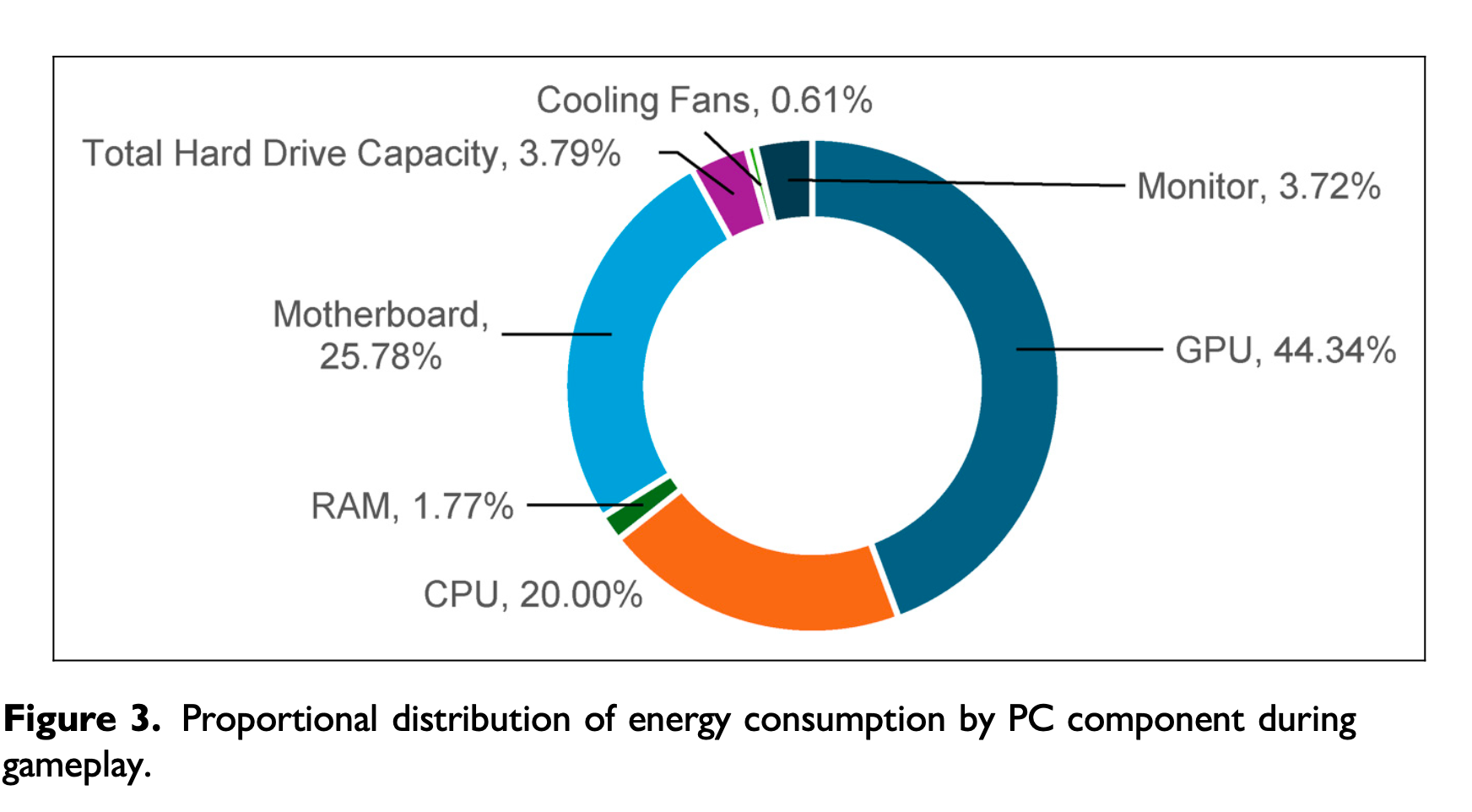
Back to Medina’s paper, though, and it’s a really thorough accounting of two game product’s likely carbon footprint, and anyone looking to do so would do well to take notes on his approach. It’s very thorough, and already giving me ideas for improvements to the model we are using in the SGA Standard. I think I have been underestimating the energy contribution of the motherboard in a PC system, and it would help explain why some of my observed measurements of my own PC power use have been higher than what my Steam hardware survey-based model would suggest. Here’s Medina’s model of the power breakdown by component:
I do think the approach is limited slightly, however, by just focusing on two (even two hugely popular) PC games, though I get why you might need to constrain the scope for a paper like this. This rears its head most in the analysis, where the paper attempts to place the results into comparison with other activities, including a benchmark against the streaming video footprint of Netflix. This choice seems to me to be slightly unfortunate, even though it’s also understandable from an expediency perspective. It just is not, to my view, an especially meaningful analytical yardstick for comparison. If the analysis were estimating the emissions all games released on Steam, then comparison to Netflix would be more appropriate, and be closer to comparing the totals for one form of leisure activity to another – though perhaps then it should also need to consider all other video streaming platforms as well… and we might then also ask to include all other gaming platforms in turn. It gets out of hand quickly, and introduces yet more data collection challenges, so I don’t have an answer.
A more apples-to-apples comparison is provided in the form of the carbon intensity of 1-hour of Netflix streaming vs 1-hour of gameplay – but that comparative data is drawn from other sources. In the paper that it comes from, Batmunkh (2022) seems to use quite different methods for estimation than Medina’s, and while I do think it’s plausible than an hour of 4K streaming Netflix uses more energy than an hour of CS2 or DoTA2 I doubt that it’s quite a whole order of magnitude larger that the comparison in the paper suggests. Likewise, comparing the annual emissions of two videogames to countries is also not especially illuminating beyond the shocking or surprising effect it generates. I do it too, so to be clear I’m not blaming the author or saying not to do it – finding ways to make greenhouse gas emissions legible to the lay reader is extremely challenging. The EPA’s Greenhouse Gas Equivalencies Calculator is probably the best solution I’ve found to this, but even that is mostly only useful for a sense of the sheer scale. That merely two games can be compared to (admittedly quite tiny in this case) countries might be the kind of wake-up call that someone needs? But I suspect that the cool and carbon-savvy GTG reader is not in that cohort. ;-) But it’s also not that informative for policy or for designing solutions. But on the whole – I think the paper is well worth reading, and super useful for others who might want to replicate the method.
The second paper I wanted to discuss is about Twitch streaming. It's by Chris Kerich and it’s titled “Twitch Synchrony: The Emissions Impact of Streaming”. In the piece, Kerich talks about the launch of the game Dragon’s Dogma 2, and the way streaming platform demands and new release timings coincide to produce a strange phenomenon, in which creators end up replicating the same introductory footage (with slightly deviations), that leads to a strange experience of synchronicity and ultimately, Kerich argues, a huge amount of “duplicate” streams:
In the first nine days after Dragon’s Dogma 2 was released, 20,216 people chose to stream the game for a cumulative 232,892 stream-hours, and those streams were viewed for a commensurate 14,591,329 watch-hours.1 Dragon’s Dogma 2 opens with a long cutscene and an extended opening tutorial, which is not unusual for a AAA action-adventure title. However, this means that anyone streaming the game from the beginning has to go through that same cutscene and tutorial.
It’s a cool and interesting observation, and Kerich has produced a fascinating video art project to illustrate the phenomenon – titled Dragons Dogma 144. You can watch it below.
The question which Kerich ends up asking, prompted by this accidental synchronicity of a great many streamers all going through the exact same cutscene and introductory tutorial is as follows:
To what extent does the ostensible efficiency of watchers gathering for a Twitch.tv stream of a game actually end up requiring greater energy than playing the game itself?
To answer this, Kerich undertakes a series of calculations of the plausible emissions resulting from the number of streams about the game Dragon’s Dogma 2, and “this ultimately gives a grand total of 639,465 kgCO2e or 639 TCO2e as the emissions impact of streaming Dragon’s Dogma 2 in the first nine days of release.” Kerich then repeats the same analytical gesture as Medina, trying to find a comparison to place the figure in a fitting scale and context:
The 639 TCO2e produced by the first nine days of Dragon’s Dogma 2 streaming are therefore equivalent to the per capita annual electricity-consumption emissions cost of 61 Albertan citizens…. [or] equivalent to 2,508 Albertan citizens consuming nine days of average electricity.
Kerich gets even more specific about the waste involved in the repetitive footage that is illustrated by Dragon’s Dogma 144, confining the analysis to just the initial streams of those that went through the same 40-minute intro to the game in the early release window:
Forty minutes across the 20,126 different streamers is 13,417 stream-hours, which is 5.76 percent of the 232,892 stream-hours in the first nine days. Thus, around 36,833 kgCO2e can be attributed to the highly similar footage showcased in Dragon’s Dogma 144 spread across all the streamers in the first nine days of release.
It’s an interesting and provocative analysis! Kerich acknowledges the possible disjunction between the steady-state availability of the physical infrastructure that streaming relies on – the 24/7 always-on data centre – and the variable nature of the demand on that infrastructure produced by any given game stream:
…much of the electricity consumption for streaming is based on the energy consumed by data centers. However, data centers remain on 24/7, regardless of how much demand is being placed on them (Marks et al. 2021, 40). In that sense, these calculations represent more of an “emissions demand” than an “emissions impact.” They show the magnitude of the emissions that are needed in order to sustain the current streaming ecosystem, rather than how much emissions are directly created by it. Here is also the environmental corollary to 24/7 time: If the games industry and streaming culture operate on 24/7 time, then infrastructure is needed that also runs on 24/7 time, and infrastructure of that type will necessarily be constantly consuming energy and producing emissions.
Kerich’s conclusions on what to do about the phenomenon of duplicate streaming are worth thinking about, though I think they’re less important than the careful process involved in coming to grips with the situation. These are not the kind of problems that can be solved by individual choices, and Kerich is quite right to suggest that “it should become clear that it is patterns of streaming consumption that need to change.” Kerich considers the effect of a “cap” on streaming infrastructure capacity – which I think is a compelling proposition, but one currently lacking the sort of champion or powerful polity needed to to exert the necessary demand for it. Such is the nature of our days that even much reviled data centres can rarely be resisted.
Another suggestion is to reduce the power demand on game hardware, which we talked about above, or to reduce stream resolutions, but I find this a bit less convincing. As I suspect Kerich does, as he notes that “the energy savings from lowering video resolution are small, but it’s undeniable that it would reduce emissions, at least a little bit.” True enough.
Kerich finishes with the following, which resonated a bit for me:
This kind of production will not be sustainable into a climate future where energy is not consistent, and it’s worth imagining different kinds of media production futures that can survive such a transition. Where can uniqueness and meaning be located in small-scale stream production?
I hope we are wrong about a future of energy inconsistency or unreliability, but I'm not confident in it with the way emissions are going. At least they've plateaued, sot they're not getting worse any faster, but we are still so far from a "safe" trajectory.
In any case, I hope both of these pieces have given you something to think about this week. Till next time, thanks for reading Greening the Games Industry.